The Shuttle Orbiter 101 “Enterprise” soars above the NASA 747 carrier aircraft after separating during the first free flight of the Shuttle Apporach and Landing Tests (ALTs) conducted on August 12, 1977 at Dryden Flight Research Center in Southern California. Astronauts Fred W. Haise Jr., and C. Gordon Fullerton were the crew of the “Enterprise.” The ALT free flights are designed to verify Orbiter subsonic airworthiness, integrated systems operations and pilot-guided approach and landing capability and satisfying prerequisites to automatic flight control and navigation mode.


9 years ago
sic itur ad astra
@spacewatching
Giving you a different, irreverent look at man in space - from the dreams of the 50s to the realities of today Sometimes it's you who give the lead to what appears in this tumblr - Keep being inquisitive as it keeps me on my toes as well...

Photo

On June 12, 1975, the Nimbus 6 satellite was launched as part of the Nimbus Earth Observation Satellites. These satellites were used to do meteorological research. Nimbus 6 took the first satellite measurements of atmospheric temperature at different altitudes.
Image taken from Madrid, C.R., ed. (1978) The Nimbus 7 Users’ Guide. Goddard Space Flight


Photo
Technicians from the McDonnell Aircraft Corporation, which was responsible for producing the Gemini capsule, make final inspections to the Gemini III spacecraft. The photo is taken in the white room, a sterile environment where the spacecraft was prepared for launch, atop the Titan launch vehicle at Pad 19 at the Kennedy Space Center. Gus Grissom and John Young would ride the spacecraft into orbit for the first Gemini mission on a five-hour trip into space on March 23, 1965.

Photo
The Gemini III spacecraft is mated with the Titan II launch vehicle in the white room of Pad 19 at the Kennedy Space Center. Virgil I. (Gus) Grissom and John Young rode the capsule into space on March 23, 1965 for a mission lasting almost five hours. The pair of astronauts tested out the spacecraft on the first manned Gemini flight.

Photo
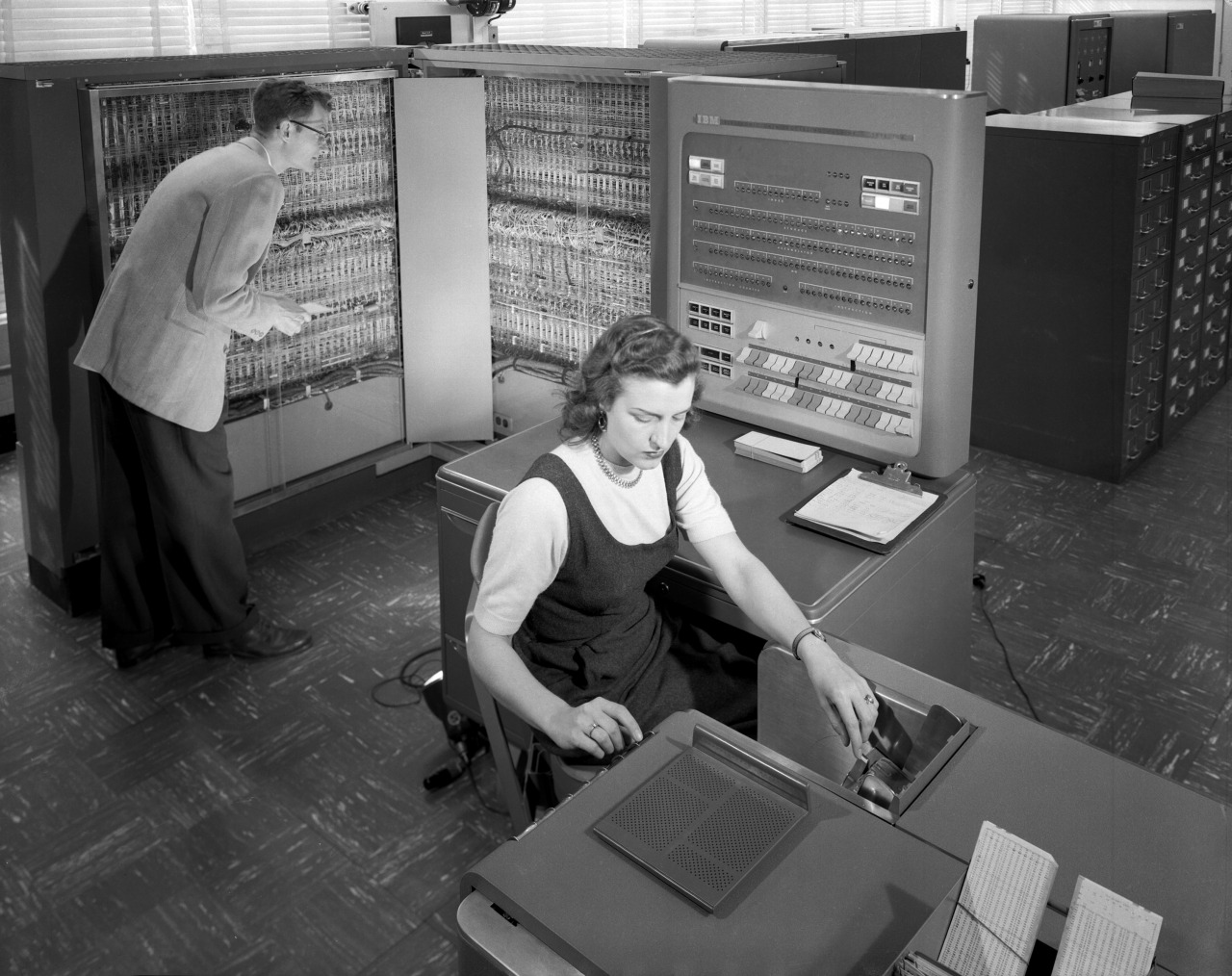
Man and woman shown working with IBM type 704 electronic data processing machine used for making computations for aeronautical research at Langley Research Center.
Photo
NASA’s 747 Shuttle Carrier Aircraft No. 911, with the space shuttle orbiter Endeavour securely mounted atop its fuselage, taxies to the runway to begin the ferry flight from Rockwell’s Plant 42 at Palmdale, California, where the orbiter was built, to the Kennedy Space Center, Florida. At Kennedy, the space vehicle was processed and launched on orbital mission STS-49, which landed at NASA’s Dryden Flight Research Facility (now Armstrong Flight Research Center), Edwards, California. NASA 911, the second modified 747 that went into service in November 1990, has special support struts atop the fuselage and internal strengthening to accommodate the added weight of the orbiters.


Photo
View of the Apollo 9 Lunar Module “Spider” in a lunar landing configuration photographed by Command Module pilot David Scott inside the Command/Service Module “Gumdrop” on the fifth day of the Apollo 9 earth-orbital mission. The landing gear on “Spider” has been deployed. lunar surface probes (sensors) extend out from the landing gear foot pads. Inside the “Spider” were astronauts James A. McDivitt, Apollo 9 Commander; and Russell L. Schweickart, Lunar Module pilot.

Photo
The Columbia Space Shuttle lifted off on March 22, 1982. Perlmutter depicted a parallel strip of tropical foliage, paying homage to the Florida landscape Columbia was leaving behind.

Photo
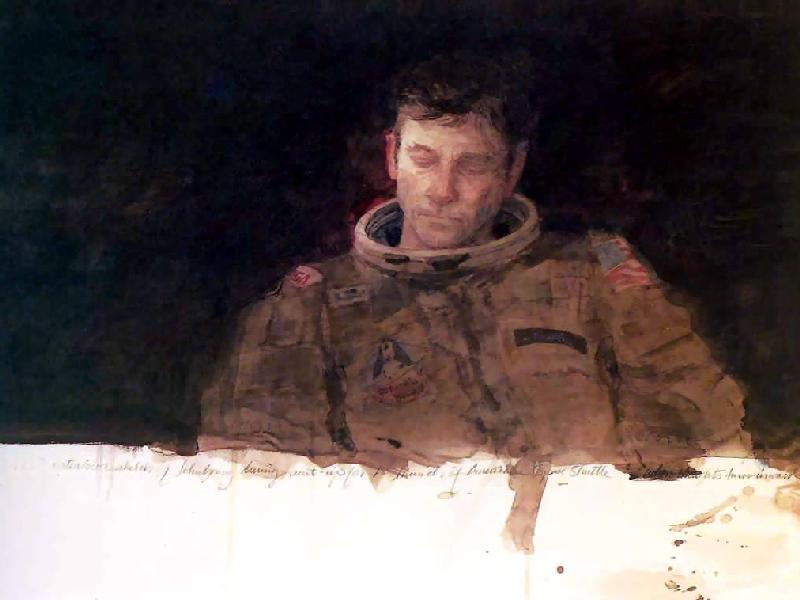
Astronaut John Young reflects pensively as he suits up for launch on April 12, 1981. Casselli conveys a quiet, almost spiritual moment when the astronaut must mentally prepare for his mission.
This was the first time that the newly inaugurated space shuttle would carry humans, in this case the two-person crew of John Young and Robert Crippen.
Photo
Engine on Torque Stand at the Aircraft Engine Research Laboratory in Cleveland, Ohio, now known as the John H. Glenn Research Center at Lewis Field. Torque is the twisting force produced by a spinning object - propellers create a lot of it.

Photo
Attired in a Russian Orlan spacesuit, astronaut Michael E. Lopez-Alegria, Expedition 14 commander and NASA space station science officer, participates in an underwater spacewalk simulation in the Hydrolab facility at the Gagarin Cosmonaut Training Center in Star City, Russia. SCUBA-equipped divers are in the water to assist the crewmembers in their rehearsal, intended to help prepare them for work on the exterior of the station.

Photo
This is the first image ever taken of Earth from the surface of a planet beyond the Moon. It was taken by the Mars Exploration Rover Spirit one hour before sunrise on the 63rd Martian day, or sol, of its mission. The image is a mosaic of images taken by the rover’s navigation camera showing a broad view of the sky, and an image taken by the rover’s panoramic camera of Earth. The contrast in the panoramic camera image was increased two times to make Earth easier to see.The inset shows a combination of four panoramic camera images zoomed in on Earth. The arrow points to Earth. Earth was too faint to be detected in images taken with the panoramic camera’s color filters.

Photo
The world’s first view of Earth taken by a spacecraft from the vicinity of the Moon. The photo was transmitted to Earth by the United States Lunar Orbiter I and received at the NASA tracking station at Robledo De Chavela near Madrid, Spain. This crescent of the Earth was photographed August 23, 1966 at 16:35 GMT when the spacecraft was on its 16th orbit and just about to pass behind the Moon.

Photo
Galileo Probe descending into Jupiter’s Atmosphere shows heat shield separation with parachute deployed, as it “hangs on the shrouds” and samples the atmosphere of the largest planet in the solar system, a key moment in the flight of Galileo. The probe entered the sunlit side of Jupiter’s atmosphere and provided the first direct sampling of the planet’s atmosphere. The Jet Propulsion Laboratory had over-all management responsibility for Galileo. NASA’s Ames Research Center was responsible for development of the probe.

Photo
After six years of silence, the thunder of human spaceflight was heard again, as the successful launch of the first space shuttle ushered in a new concept in utilization of space. Mission STS-1, on Space Shuttle Columbia, launched from Launch Complex 39A at Kennedy Space Center just seconds past 7 a.m. on April 12, 1981. It carried astronauts John Young and Robert Crippen on an Earth-orbital mission scheduled to last for 54 hours. The mission ended with the Space Shuttle Columbia landing at Edwards Air Force Base in California.

Photo
Against a black sky, the Space Shuttle Endeavour and its seven-member STS-123 crew head toward Earth-orbit and a scheduled link-up with the International Space Station (ISS). Liftoff was on time at 2:28 a.m. (EDT). Onboard are NASA astronauts Dominic Gorie, commander; Gregory H. Johnson, pilot; Robert L. Behnken, Mike Foreman, Rick Linnehan, Garrett Reisman and Japan Aerospace Exploration Agency (JAXA) astronaut Takao Doi, all mission specialists. The crew will make a record-breaking 16-day mission to the International Space Station and deliver the first section of the Japan Aerospace Exploration Agency’s Kibo laboratory and the Canadian Space Agency’s two-armed robotic system, Dextre. Reisman will join Expedition 16 in progress to serve as a flight engineer aboard the ISS.

Photo
The two Soviet crewmen for the Apollo-Soyuz Test Project mission are photographed at the launch pad at the Baikonur Cosmodrome in Kazakhstan on the morning of the Soviet ASTP liftoff on July 15, 1975. They are cosmonauts Aleksey A. Leonov (left), commander; and Valeriy N. Kubasov, flight engineer. The Soviet ASTP launch preceded the American ASTP Apollo liftoff by seven and one-half hours. The American and Soviet spacecraft were docked in Earth orbit for a total of about 47 hours on July 17-19, 1975.

Photo
The official portrait of the STS-5 crew. From left to right they are Joseph Allen, mission specialist; Vance Brand, STS-5 commander; Robert Overmyer, pilot; and William Lenoir, mission specialist.

Photo
The Field Integrated Design and Operations (FIDO) rover is being used in ongoing NASA field tests to simulate driving conditions on Mars. FIDO is at a geologically interesting site in central Nevada while it is controlled from the mission control room at JPL’s Planetary Robotics Laboratory in Pasadena. FIDO uses a robot arm to manipulate science instruments and it has a new mini-corer or drill to extract and cache rock samples. Several camera systems onboard allow the rover to collect science and navigation images by remote-control. The rover is about the size of a coffee table and weighs as much as a St. Bernard, about 70 kilograms (150 pounds). It is approximately 85 centimeters (about 33 inches) wide, 105 centimeters (41 inches) long, and 55 centimeters (22 inches) high. The rover moves up to 300 meters an hour (less than a mile per hour) over smooth terrain, using its onboard stereo vision systems to detect and avoid obstacles as it travels “on-the-fly.” During these tests, FIDO is powered by both solar panels that cover the top of the rover and by replaceable, rechargeable batteries.

Photo
Following the Space Shuttle Challenger accident in January 1986, President Reagan appointed a Presidential Commission to investigate the accident. The fourteen members of the Commission included former Secretary of State William Rogers as chairman, astronauts Sally Ride and Neil Armstrong, and Nobel Prize winner Richard Feynman. After months of investigation, the Rogers Commission identified the cause of failure as an O- ring in the right Solid Rocket Booster that ruptured due to the cold temperatures of the launch.
Here, Alton Keel (left), the representative to the Commission from the Executive Office of the President, and chairman William Rogers (center) arrive at the Galaxie Theatre at KSC’s Visitor’s Information Center for a one day briefing and tour of the NASA facility

Photo
Astronaut Guion S. Bluford and Aviation Safety Officer Charles F. Hayes got a unique perspective of their environment during a zero gravity flight. They are aboard a KC-135 aircraft, also known as the vomit comet, which flies a special parabolic pattern repeatedly to afford a series of 30-seconds-of-weightlessness sessions. Bluford and Hayes are being assisted by C.P. Stanley of the photography branch of the photographic technology division at JSC. Some medical studies and motion sickness experiments were conducted on this particular flight. Bluford is one of 20 scientist astronauts who began training at JSC in July 1978.

Photo
Soviet cosmonaut Yuri Gagarin (front left) shakes hand with NASA’s Gemini 4 astronauts, Edward H. White II (middle, facing camera) and James A. McDivitt (right front) at the Paris Air Show in June 1965. This meeting between Gagarin and the Gemini 4 astronauts occurred shortly after the completion of the Gemini 4 mission, where White performed the first American EVA. Yuri Gagarin achieved fame as the first human to orbit Earth. Also shown in the picture (seated between Gagarin and White) are Vice President Hubert H. Humphrey and (standing between White and Grissom) French Premier Georges Pompidou.

Photo
Thank you everyone for this great journey through the past, present & future of space

Photo
A massive 19 million pounds (8.6 million kilograms) of Space Shuttle, support and transport hardware, inch toward Launch Pad 39A from the Vehicle Assembly Building. The fully assembled Space Shuttle Endeavour, minus its payloads, weighs about 4.5 million pounds (2 million kg.); the mobile launch platform on which it was stacked and from which it will lift off weighs 9.25 million pounds (4.19 million kg.) and the crawler-transporter carrying the platform and Shuttle checks in at around 6 million pounds (2.7 million kg.). Once at the pad, the Shuttle and launch platform will be positioned atop support columns to complete preparations for the second Shuttle launch of 1995. Primary payload of Mission STS-67 is the Astro-2 astrophysics observatory, carrying three ultraviolet telescopes that flew on the Astro-1 mission in 1990. STS-67 also is scheduled to become the longest Shuttle flight to date, lasting 16 days.

Photo
Eugene A. Cernan, Commander, Apollo 17 salutes the flag on the lunar surface during extravehicular activity (EVA) on NASA’s final lunar landing mission. The Lunar Module “Challenger” is in the left background behind the flag and the Lunar Roving Vehicle (LRV) also in background behind him. While astronauts Cernan and Schmitt descended in the Challenger to explore the Taurus-Littrow region of the Moon, astronaut Ronald E. Evans, Command Module pilot, remained with the Command/Service Module (CSM) “America” in lunar-orbit.

Photo
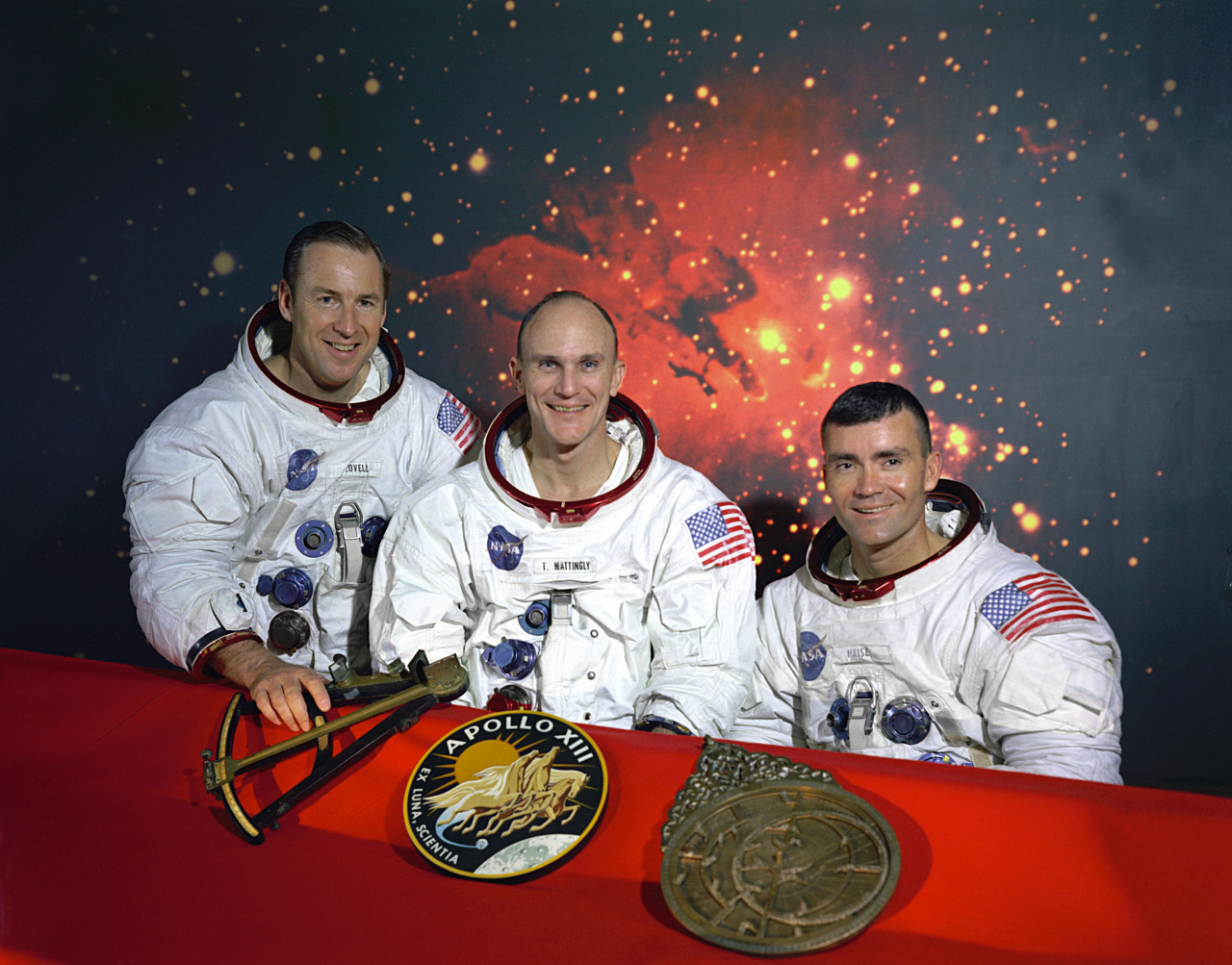
The original Apollo 13 prime crew. From left to right are: Commander, James A. Lovell, Command Module pilot, Thomas K. Mattingly and Lunar Module pilot, Fred W. Haise. On the table in front of them are from left to right, a model of a sextant, the Apollo 13 insignia, and a model of an astrolabe. The sextant and astrolabe are two ancient forms of navigation. Command Module pilot Thomas “Ken” Mattingly was exposed to German measles prior to his mission and was replaced by his backup, Command Module pilot, John L.“Jack” Swigert Jr.
Photo
View of the Apollo 9 Lunar Module “Spider,” in a lunar landing configuration, as photographed form the Command/Service Module on the fifth day of the Apollo 9 earth-orbital mission. The landing gear on the Lunar Module has been deployed. Note Lunar Module’s upper hatch and docking tunnel. The EVA foot restraints known as the “Golden Slippers” are visible on the porch of the Lunar Module (LM). They allowed Lunar Module pilot Russell “Rusty” Schweickart to securely stand on the porch during his EVA thus allowing him free use of his hands.
