i should’ve shoved that little bear right up his tight ass—


Silvergate, once known as a crypto-friendly bank, faces significant changes as CEO Alan Lane and two other key executives prepare to leave. Alan Lane and the firm’s chief legal officer, John Bonino, will step down on Aug. 15. Antonio Martino,…
Binance’s depleting USDC reserves has become a hot topic in the crypto ecosystem, especially after Coinbase CEO’s quip during the company’s Q2 earning call.

Bank records and company messages have revealed that Binance US relied on Binance to process payments and cover payroll, in complete contradiction to the firm’s insistence that it operated independently, Reuters reported on Monday.
Now-defunct Silvergate Bank authorized Binance exec Guangying Chen to move funds held in Binance US accounts in 2019 and 2020, bank records revealed. Chen, a close…

Silvergate Bank to cut 230 staff as it winds down
Silvergate Bank will significantly reduce its staff headcount as it winds down operations, according to an SEC filing submitted May 11.
The failed crypto-friendly bank will let go of about 230 employees on May 12, leaving just 80 officers and employees at the firm.
The remaining staff will continue to pursue the company’s liquidation, will cooperate with inquiries and investigations, and will attempt to preserve the remaining value of the company’s assets.
Additional reductions would also take place on June 30, Aug. 30, and Nov. 30 of this year, but it was not stated how many staff would be laid off on those dates, according to the filing.
The bank will spend $10.7 million on severance and retention bonus payments. The company will also spend $2.8 million on employee benefits and job placements, meaning that the reduction will cost Silvergate about $13.6 million.
Silvergate Bank announced it would halt operations and undergo liquidation on March 8. It experienced a bank run shortly before that when it submitted an SEC filing disclosing apparent difficulties. Specifically, the bank said it would be unable to file its 10-K report — and the company reiterated its inability to do so in today’s filing.
Numerous crypto companies used Silvergate for certain transactions, while others had financial exposure to the company. However, several companies distanced themselves from Silvergate prior to or during the company’s March collapse.
The post Silvergate Bank to cut 230 staff as it winds down appeared first on CryptoSlate.
GameFi News
The collapse of Signature Bank and Silvergate Bank, two of the most crypto-friendly lenders in the U.S., has left many cryptocurrency firms in a state of uncertainty and desperation.
The Treasury Secretary of the U.S. Janet Yellen said the federal government will intervene if it is necessary to protect other small lenders.

According to research from Coinbase and CES Insights, the U.S. government has taken swift steps to avert a system-wide bank run among mid-tier banks after the failure of Silicon Valley Bank (SVB) and Silvergate.

“Also among Lane’s clients: FTX. Federal prosecutors are now examining Silvergate’s role in banking Sam Bankman-Fried’s fallen empire. The more pressing problem is that the collapse of FTX spooked other Silvergate customers, resulting in an $8.1 billion run on the bank: 60 percent of its deposits that walked out the door in just one quarter. (“Worse than that experienced by the average bank to close in the Great Depression,” The Wall Street Journal helpfully explained.)
In its earnings filing, we found out that Silvergate’s results last quarter were absolute dogshit, a $1 billion loss. Then, on March 1st, Silvergate entered a surprise regulatory filing. It says that, actually, the quarterly results were even worse, and it’s not clear the bank will be able to stay in business.
(…)
“If Silvergate goes out of business, it’s going to push funds and market makers further offshore,” Ava Labs president John Wu told Barron’s. The issue is how easy it is to get into actual cash dollars, which in finance-speak is called liquidity. Less liquidity makes transactions more difficult. Already there is a broader gap between the price at which a trade is expected to go through at and the actual price at which it executes, Wu said.
So Silvergate’s troubles are a problem for the entire crypto industry.”
Here’s how the second-biggest bank collapse in U.S. history happened in just 48 hours
“Within 48 hours, a panic induced by the very venture capital community that SVB had served and nurtured ended the bank’s 40-year-run.
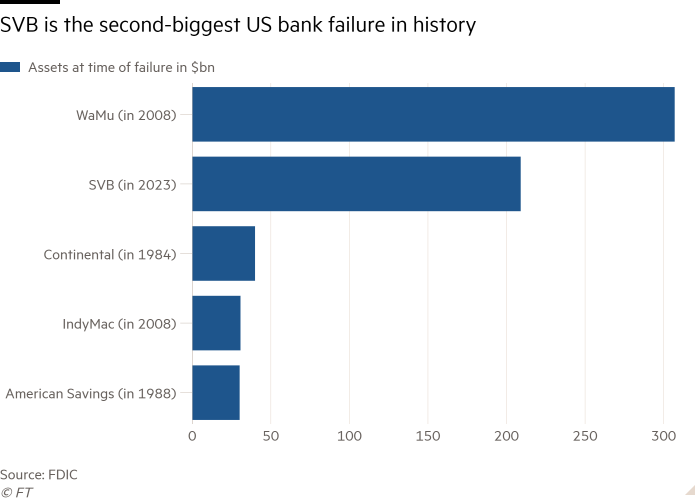
Regulators shuttered SVB Friday and seized its deposits in the largest U.S. banking failure since the 2008 financial crisis and the second-largest ever. The company’s downward spiral began late Wednesday, when it surprised investors with news that it needed to raise $2.25 billion to shore up its balance sheet. What followed was the rapid collapse of a highly-respected bank that had grown alongside its technology clients.
(…)
“This was a hysteria-induced bank run caused by VCs,” Ryan Falvey, a fintech investor at Restive Ventures, told CNBC. “This is going to go down as one of the ultimate cases of an industry cutting its nose off to spite its face.”
(…)
The roots of SVB’s collapse stem from dislocations spurred by higher rates. As startup clients withdrew deposits to keep their companies afloat in a chilly environment for IPOs and private fundraising, SVB found itself short on capital. It had been forced to sell all of its available-for-sale bonds at a $1.8 billion loss, the bank said late Wednesday.
(…)
All told, customers withdrew a staggering $42 billion of deposits by the end of Thursday, according to a California regulatory filing.
By the close of business that day, SVB had a negative cash balance of $958 million, according to the filing, and failed to scrounge enough collateral from other sources, the regulator said.
(…)
Now, thanks to the bank run that ended in SVB’s seizure, those who remained with SVB face an uncertain timeline for retrieving their money. While insured deposits are expected to be available as early as Monday, the lion’s share of deposits held by SVB were uninsured, and it’s unclear when they will be freed up.”
First Republic Hit by Silicon Valley Bank Failure
“First Republic shares fell 52% in early trading before storming back to near the previous day’s closing level, only to then finish the day down 15%. Investors expressed concerns about unrealized losses on assets at the bank as well as its heavy reliance on deposits that could turn out to be flighty.
(…)
First Republic’s shares have lost 34% of their value in the past week.
(…)
In its annual report, First Republic said the fair-market value of its “real estate secured mortgages” was $117.5 billion as of Dec. 31, or $19.3 billion below their $136.8 billion balance-sheet value. The fair-value gap for that single asset category was larger than First Republic’s $17.4 billion of total equity.
All told, the fair value of First Republic’s financial assets was $26.9 billion less than their balance-sheet value. The financial assets included “other loans” with a fair value of $26.4 billion, or $2.9 billion below their $29.3 billion carrying amount. So-called held-to-maturity securities, consisting mostly of municipal bonds, had a fair value of $23.6 billion, or $4.8 billion less than their $28.3 billion carrying amount.
(…)
Total deposits at First Republic were $176.4 billion, or 90% of its total liabilities, as of Dec. 31. About 35% of its deposits were noninter-est-bearing. And $119.5 billion, or 68%, of its deposits were uninsured, meaning they exceeded Federal Deposit Insurance Corp. limits.”
Regulators seize Signature Bank in third-largest US bank failure
“Signature becomes the third-largest bank to ever fail in the U.S., behind Silicon Valley Bank and Washington Mutual in 2008, if its assets haven’t changed significantly since the end of 2022. Signature had $110 billion in assets as of Dec. 31, ranking 29th among U.S. banks. It had $88 billion in deposits as of that date, and approximately 89.7% were not insured by the Federal Deposit Insurance Corporation.
(…)
Signature served clients in the cryptocurrency world and had been trying to reduce its exposure. Like Silvergate Bank, another crypto-friendly bank that said last week it would voluntarily wind itself down, it suffered from a deposit outflow in the aftermath of the collapse of crypto exchange FTX. Deposits dropped 17% in the fourth quarter of 2022 as compared to the year-earlier period.
(…)
Now that Signature has been seized, Circle, issuer of the second largest stablecoin, “will not be able to process minting and redemption [for the stablecoin] through SigNet,” and “will be relying on settlements through BNY Mellon,” CEO Jeremy Allaire said on Twitter Sunday evening.
Circle’s USD coin fell below its crucial $1 peg Friday after the company disclosed $3.3 billion in cash reserves held with the failed Silicon Valley Bank despite attempted withdrawals Thursday. After falling to 88 cents on Saturday, the company announced it planned to cover any shortfall from its SVB losses using “corporate resources.””
Credit Suisse shares fall to new record low after collapse of SVB and Signature Bank
“Credit Suisse shares on Monday reached a new record low, falling as much as 15% as investors continued to hammer away at the stock of the Swiss banking giant after the collapse of banks in the U.S.
(…)
Credit Suisse CSGN CS has lost money for five straight quarters and says it’s expecting to post a loss before tax this year. It’s undergoing a big transformation after losing billions lending to the Archegos family office and having to freeze $10 billion worth of funds tied to Greensil Capital. Wealthy clients pulled out about $100 billion from Credit Suisse in the fourth quarter.”

Hey guys, check out our latest video- #Silvergate Collapse | Seized 40k #BTC by in motion | #SEC denies #VanEck trust | NY sues #KuCoin
🔰Credits to the original news content sources-
1- #JPMorgan Says Silvergate #Collapse Will Test #CryptoIndustry- https://beincrypto.com/jpmorgan-silvergate-collapse-test-crypto-industry/
2- 40,000 BTC from #USGovernment Seizures in Motion: What Could It Mean for Bitcoin?- https://zycrypto.com/40000-btc-from-us-government-seizures-in-motion-what-could-it-mean-for-bitcoin/
3- SEC denies VanEck spot #BTCtrust product, commissioners see double standard- https://cointelegraph.com/news/sec-disapproves-vaneck-spot-btc-trust-product-commissioners-see-double-standard
4- New York #sues KuCoin, claims ether is an unregistered #security- https://www.theblock.co/post/218600/new-york-sues-kucoin-claims-ether-is-an-unregistered-security
——————————————————————————————————————
🔰If you Want to get 100 USDT, Register on the world’s biggest crypto exchange- Binance and deposit more than $50 into your account. We’ll both get a 100 USDT cashback voucher! 👉 https://bit.ly/bobinance
#️⃣ Let’s connect on Social Media:🌎 :
👍All links here (IG, Twitter, etc) - https://linktr.ee/cryptoikonmedia
📼 Also Streaming on Theta: https://www.theta.tv/cryptoikonmedia
💼 Business Inquiries: cryptoikonmedia@gmail.com
😎 Common username on all other major platform: @cryptoikonmedia
🔰About us:
CryptoIkon Media is a full-service Interactive #Crypto Media Agency. We provide 360-Degree Digital Branding & Marketing services to (Crypto, Defi, NFT, Web3, Metaverse & Blockchain) projects and companies.
———————————————————————————————————————
Disclaimer: Our content is not financial advice, legal advice or tax advice in any way, shape or form. Please do your own research. DM for credit or removal request (no copyright intended) ©️ All rights and credits reserved to the respective owner(s)
.
.
.
.
.
.
#cryptonews #cryptocurrency #bitcoin #cryptotrading #blockchain #ethereum #btc #cryptocurrencies #bitcoinnews #bitcoins #cryptoworld #cryptoinvestor #eth #cryptocurrencynews
=============
bob, bobasheesh, bobasheesh, cim, cryptoikonmedia, cryptoikonmedia, cry (at Delhi/Gurgaon/NCR)
https://www.instagram.com/p/CpqkxOYh_xq/?igshid=NGJjMDIxMWI=

Silvergate: A postmortem | CryptoSlate
Silvergate bank announced it would begin winding down operations and undergo voluntary liquidation.
On March 8, the bank said it was exploring how it could resolve claims and ensure the continued residual value of its asset while repaying all deposits to clients. The decision was made in light of “recent industry and regulatory developments,” its holdings company Silvergate Capital said.
The announcement came days after the bank announced it would halt the Silvergate Exchange Network (SEN), its real-time settlement service. On March 3, Silvergate submitted an SEC filing stating that it faced inquiries from the U.S. Department of Justice (DOJ) and would file a late 10-K report.
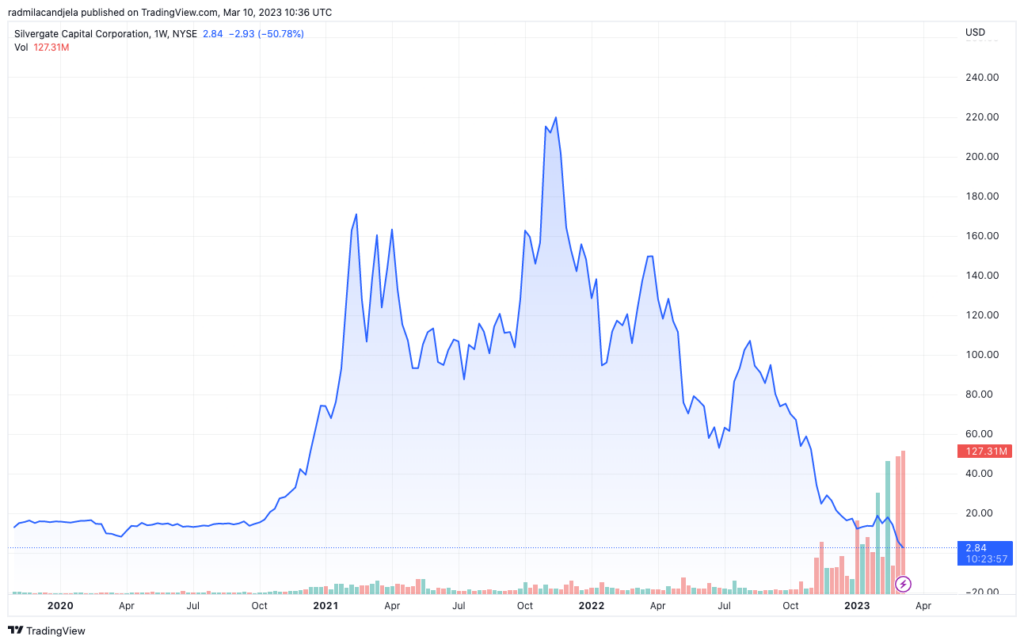
While the bank’s troubles culminated on March 8 with the liquidation announcement, it has struggled for several months. Since the collapse of FTX in November 2022, the bank has seen its stock price depreciate by over 94%.
The most significant 24-hour loss was recorded between March 1 and March 2, when the NASDAQ-listed SI dropped 57%.
The news sent shockwaves through the crypto market, as the U.S. bank served as the backbone for the crypto market, providing financial services to most large crypto companies and exchanges in the country.
Bitcoin dropped to its January low of $19,680 after trading flat at around $21,000 for over a month. The total crypto market cap dipped below $1 trillion, struggling to retain $880 billion at press time.
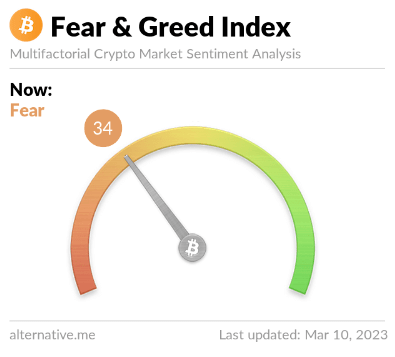
The crypto fear and greed index has gradually decreased and shows fear. Declining trading volumes and growing exchange withdrawals show investor sentiment is worsening daily.
Despite still being operational, Silvergate has had a profound effect on the market. It triggered a domino effect that will affect not only cryptocurrency companies in the U.S. but the entire banking sector in the country.
In this report, CryptoSlate dives deep into Silvergate to see what brought the former banking giant to its knees and how other banks could share its destiny.
Silvergate was founded in 1988 and began an initiative to service cryptocurrency clients in 2013 after its CEO Alan Lane personally invested in Bitcoin. Further research into cryptocurrencies showed that the market was missing banking services, a hole Silvergate was the first and the quickest to fill.
Silvergate’s decision to stop its mortgage operations in 2005 helped it weather the storm caused by the subprime mortgage meltdown. When the Great Financial Crisis hit in 2008, the bank was among the few in the country who could lend. However, the bank lacked customer deposits to fund these loans and was looking for ways to attract new customers.
The crypto industry in the U.S. was filled with companies with nowhere to go. With Silvergate positioning itself as the sole savior of what can only be described as a banking crisis in crypto, it saw its deposits double in a year. In 2018, it serviced over 250 international clients in the crypto space. As of September 2022, Silvergate had 1,677 customers using SEN.
This was primarily due to Silvergate’s innovative approach to servicing the industry. Instead of just providing custody services to crypto clients, the bank created the Silvergate Exchange Network (SEN), a real-time settlement service that enabled the seamless flow of dollars and euros between crypto companies. The service was revolutionary at the time, as no other bank had real-time payment capabilities that would match the 24/7 payment needs of the crypto industry.
The bank’s services quickly grew to accommodate the rising appetite of the industry — it saw hundreds of millions of dollars in additional investments and began providing Bitcoin-collateralized loans to clients.
As Silvergate charged no fees to use SEN and its customer deposits didn’t bear any interest rates, it profited by using the deposits to invest in bonds or issue loans to earn money on the spread. A Forbes report from October 2022 showed that commitments to SEN Leverage reached $1.5 billion, up from $1.4 billion recorded in June.
This modest growth reflected the relatively flat deposits the bank saw throughout 2022. After its parabolic rise in 2020 and 2021 during the bull market, deposits peaked in the first quarter of 2022 as the network became fully saturated.
Then, FTX collapsed and began wreaking havoc on the market. Bitcoin dipped to a two-year low of $15,500, dragging the rest of the market deep into the red. Over $4 billion worth of customer funds on FTX threatened to be lost forever, prompting regulators worldwide to keep a watchful eye on the industry.
And while Silvergate had no lending relationship with FTX, it failed to remain immune from the fallout.
It began seeing an alarming increase in withdrawals as the fourth quarter began. CryptoSlate’s analysis at the time noted that the market was becoming worried that the contagion from FTX could spread to Silvergate’s other creditors. The bank’s ten biggest depositors, which included Coinbase, Paxos, Crypto.com, Gemini, Kraken, Bitstamp, and Circle, accounted for half of its deposits at the end of the third quarter.
Silvergate began borrowing against the long-dated assets it held to combat its dwindling deposits, mostly U.S. treasuries and agency bonds. However, it failed to keep the market at bay and prevent further withdrawals, forcing it to begin selling the assets to pay out its depositors.
With rising interest rates and dangerously high inflation, Silverage reportedly lost at least $700 million on selling $5.2 million worth of bonds in the fourth quarter and took another $300 million on a fair-value adjustment of its remaining portfolio.
At the beginning of November 2022, Silvergate had $11.9 billion in customer deposits. By the end of December 2022, its deposits dropped to $3.8 billion.
While it might take several months for Silvergate to wind down its operations, its effect on the market is already evident. Market sentiment seems to have sloped to a new low, with both retail and institutional investors losing the little confidence they had in banking institutions.
Stock prices for some of the other leading cryptocurrency banks are beginning to show this.
Signature Bank, another large U.S. bank focused on providing services to crypto companies, saw its stock drop over 34% since the beginning of February. SBNY posted a 12% loss between March 7 and March 8. This is a significant loss for the bank, whose crypto deposits comprise only 15% of its total deposits. The bank also doesn’t engage in crypto-backed lending or hold cryptocurrencies on its clients’ behalf. It also signed on several large clients that left Silvergate, including LedgerX and Coinbase.
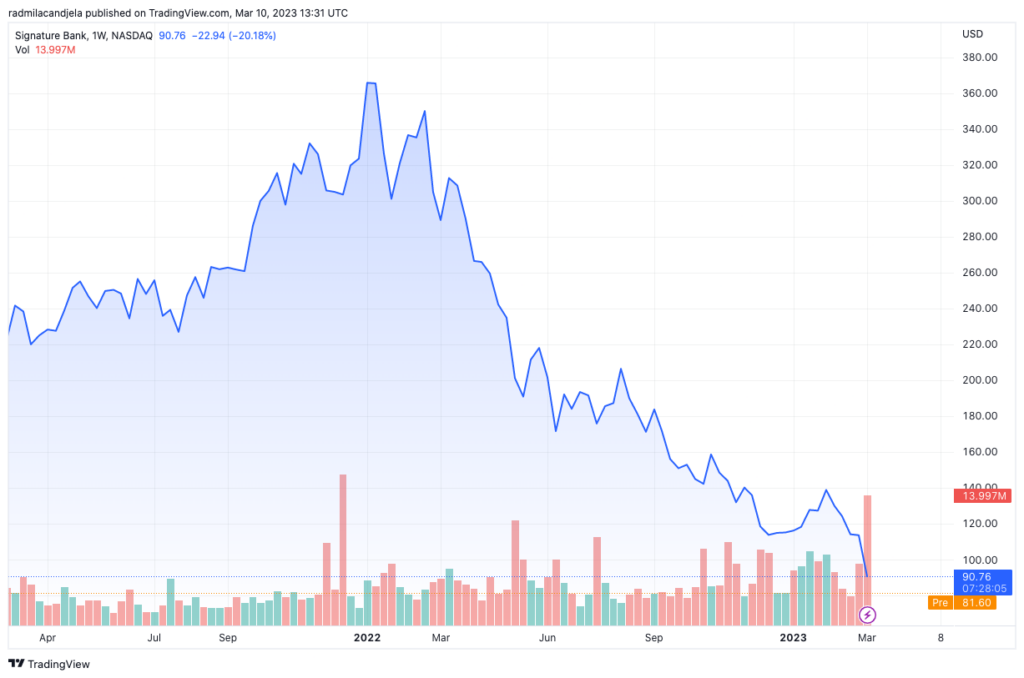
Despite Barron’s assessment that Signature is still a good buy, expecting its stock to regain its ATH in a relatively short time frame, confidence in the sector is at its all-time low.
After a tumultuous week, Silicon Valley Bank was closed on Friday, March 10.
The New York-based bank saw its stock drop over 62% since the beginning of March after losing 12% in February. Shares of SVB Financial, the bank’s holding company, followed Signature’s pattern — they peaked in October 2021 at the height of the bull market, posting a 176% YoY growth.
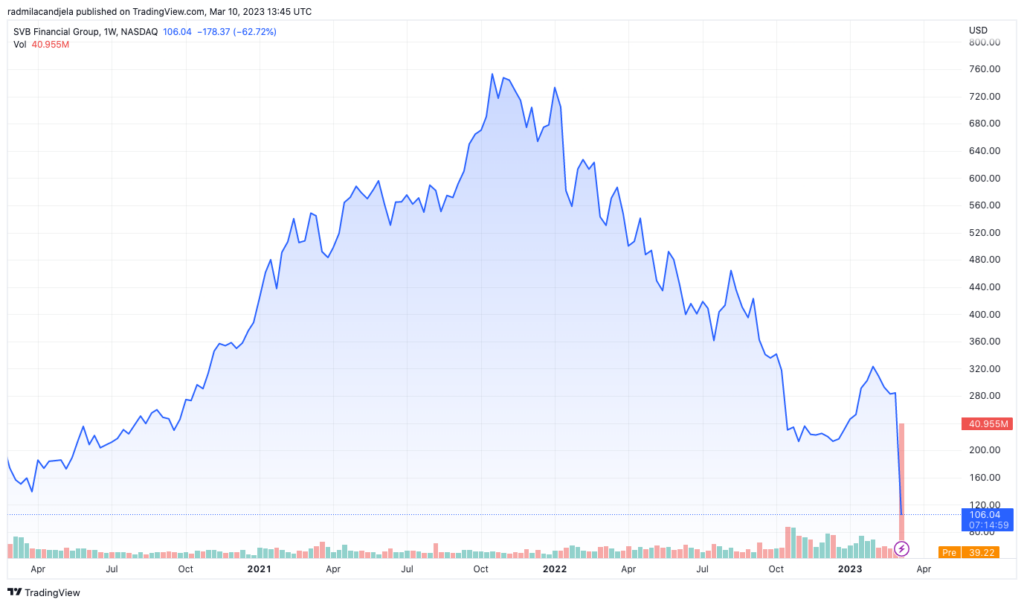
The almost vertical drop in the bank’s stock price followed the announcement that the bank needed to raise $2.25 billion in stock. Broader market turmoil pushed many of SVB’s startup and tech clients to withdraw their deposits, pushing the bank to sell “substantially all” of its available-for-sale securities at a $1.8 billion loss.
The bank faced a perfect storm. Clients were pulling their deposits at an alarming rate as they feared the domino effect caused by Silvergate. Its clients, made up mostly of high-growth startups, are seeing a notable decrease in VC funding activity and an increase in cash burn as the market begins to slow down. Morgan Stanley noted that this was the main driver for the decline in SVB’s client funds and on-balance-sheet deposits, even though they said the bank had “more than enough liquidity” to fund these outflows.
However, sources close to the bank revealed on Friday that the bank was reportedly in talks to sell itself as its attempts to raise capital have failed. CNBC reported that “large financial institutions” were looking at the potential purchase of SVB.
Then, the California Department of Financial Protection and Innovation closed SVB on March 10, appointing the FDIC as a receiver. A new bank was created — the National Bank of Santa Clara — to hold the insured deposits on behalf of SVB’s clients. FDIC noted that the bank would be operational as of Monday, with all SVB’s insured depositors having full access to their insured deposits. This means that clients with deposits exceeding $250,000 will receive a receivership certificate that would enable them to redeem their uninsured funds in the future.
Other financial stocks continue to stumble. Spooked by SVB’s securities sell-off and its subsequent shutdown, investors began dumping shares of other large banks in the U.S. The four biggest banks in the U.S. — JPMorgan, Bank of America, Wells Fargo, and Citigroup, lost $54 billion in market value on Thursday, March 9.
JPMorgan suffered the most significant loss, seeing its market cap drop by around $22 billion. Bank of America followed with a $16 billion loss, while Wells Fargo’s market cap was down $10 billion. Citigroup posted a $4 billion loss.
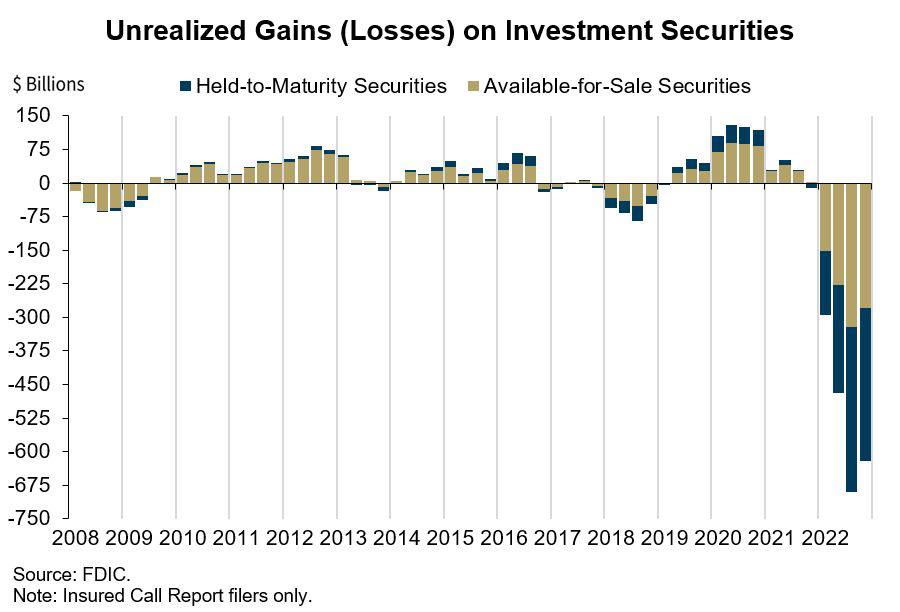
None of the large legacy banks in the U.S. have so far been faced with deposit withdrawals like the ones Silvergate and SVB experienced. Nonetheless, investors seem frightened that the banks won’t be able to meet the outflow demand, as most hold large amounts of long-term maturity assets. Acquired when interest rates were historically low, these securities are worth significantly less than their face values. The Federal Deposit Insurance Corporation (FDIC) estimated that U.S. banks held around $620 billion in unrealized losses on these securities at the end of 2022.
The contagion from Silvergate has spread to Europe as well.
Credit Suisse, one of the largest banks in Europe, saw its shares drop to their all-time low on Friday, March 10, leading other European banking stocks down with it.
And while the loss Europe’s STOXX banking index saw was just 4.2%, it still represents the biggest one-day slide since June 2022. Other major banks in the E.U. also saw significant losses, with HSBC posting a 4.5% loss and Deutsche Bank dropping 7.8%.
The collapse of FTX triggered an unprecedented regulatory crackdown on the crypto industry. This has been most apparent in the U.S., where lawmakers have been fighting a vicious fight over how to regulate the booming market.
The collapse of FTX only added fuel to the fire, creating an aggressive new movement that set its sights on tightening its reigns on the industry.
Earlier this week, Sen. Elizabeth Warren said that Silvergate’s failure was disappointing but predictable:
“I warned of Silvergate’s risky, if not illegal, activity — and identified severe due diligence failures. Now customers must be made whole, and regulators should step up against crypto risk.”
Warren’s criticism wasn’t met with approval, though. Aside from the generally negative market reaction, four Republican senators sent a letter to the Board of Governors of the Federal Reserve condemning the increased regulatory pressure.
In the letter, they stated that the organized attempt to de-bank the crypto industry was “disturbingly reminiscent” of Operation Choke Point. They called for the Federal Reserve, FDIC, and OCC not to punish the entire crypto industry as the overreaching behavior of banking regulators will inevitably bleed into other industries.
On March 10, U.S. Treasury Secretary Janet Yellen met with officials from the Federal Reserve, FDIC, and OCC to discuss the situation regarding SVB. Later that day, while testifying before a House Ways and Means Committee hearing, she said that U.S. regulators were monitoring several banks affected by recent developments.
It took over four months of market turmoil to bring Silvergate to its knees. However, the domino effect it triggered led to exponentially faster deaths for other institutions in line behind it.
Silicon Valley Bank closed down after less than a week of speculation about its solvency. It took hours to become a poster child for the crypto banking crisis — SVB is now the second-biggest bank failure in the U.S. ever recorded.
However, the domino effect that began with Silvergate hasn’t ended with Silicon Valley Bank. The full scope of the blowback is yet to be felt as both banks will take months to wind down their operations.
In the meantime, bank runs are set to threaten even more financial institutions servicing the crypto and tech industries. We can expect other small to mid-size banks to struggle with paying out customer deposits.
The crypto banking sector’s unfortunate but most likely future will be aggressive centralization and corporatization. As more and more boutique banks shut down, large crypto companies and exchanges will flock to large legacy banks. Small crypto companies will continue to struggle securing banking services, leading to mass relocations or cheaper acquisitions by larger competitors.
GameFi News

Are Failing Banks About to Destroy the Economy?
With two banks now totally collapsed, many are now worried about contagion—that is, whether the collapse of these niche banks could spiral out into the wider economy. Shares of other banks in the U.S. (largely on the West Coast) fell precipitously on the news. European banks are also feeling the squeeze as share prices drop, and even larger banks like Bank of America and JPMorgan saw dips in their stock price.
The right way to see this situation, however, might be that the contagion has already spread; Silvergate and SVB failing won’t wreck the economy, rather, they are failing because the economy is already wrecked.

Silvergate…silicone valley bank…what are your thoughts?
It feels like 2008 all over again, we might be facing a bigger crash this time
What are we shorting?😂📉
BTC price targets extend to $18,000 with Bitcoin bulls increasingly failing to preserve $20,000 as support amid further SVB Financial fallout.

Binance, is still dominating in shares despite the recent market events that saw recent plunges. This comes as Silvergate and Coinbase both recorded drops in stock valuations.

GM! ✨
It’s understandable to feel worried and uncertain during times of market volatility and unexpected events like #Silvergate shutting down. However, it’s important to keep a level head and avoid making rash decisions based on emotions. #StayStrong and remain #Positive. Remember, the #Web3 industry is constantly #evolving and presents #exciting opportunities for #growth and #innovation.
#Fomokun #NFT #Web5 #IP #TogetherBetter (at Pavilion Bukit Jalil)
https://www.instagram.com/p/Cpl-rLjL0Ak/?igshid=NGJjMDIxMWI=

Crypto Friendly Bank Silvergate Shuts Down
Silvergate Bank is winding down operations, but it assured that all customer deposits would be fully repaid.
Another pillar of the crypto industry has succumbed.
Silvergate Capital Corporation, the holding company for Silvergate Bank, announced yesterday its intent to completely wind down operations.
The bank indicated in its press release that it would be voluntarily undergoing liquidation “in an orderly manner and in accordance with applicable regulatory processes.” The bank stated that all customer deposits would be fully repaid, and that it was currently figuring out how to resolve claims and preserve the value of its assets.
Silvergate told the Securities and Exchange Commission at the beginning of the month that it was perhaps “less than well-capitalized” and that it was “reevaluating its business”. The company also admitted to being uncertain about its ability to continue operating. The news sent shockwaves through the crypto industry, with major firms such as Coinbase, Paxos, Circle, Galaxy Digital, and CBOE all quickly announcing they were pausing transactions to and from Silvergate.
Shortly thereafter, Silvergate made the decision to discontinue the Silvergate Exchange Network (SEN), which it used to enable customers to exchange government-issued currencies for cryptocurrencies.
Silvergate had previously disclosed a $1.05 billion loss in the fourth quarter of 2022 due to the “crisis of confidence” the crypto industry experienced following FTX’s collapse. However, former FDIC chair Sheila Bair told Bloomberg yesterday that “Silvergate’s troubles [were] as much if not more about traditional banking risks—lack of diversification, maturity mismatches—as it is about its exposure to crypto.”
Disclosure: At the time of writing, the author of this piece owned BTC, ETH, and several other crypto assets.
Crypto News
The recent demise on silvergate has caused an uproar on social media as each party tries to give their opinion on the demise’s cause. Both the crypto community and government executives have commented.
Silvergate troubles affecting crypto’s USD market depth
Crypto’s US Dollar market depth has significantly dropped over the past month following Silvergate’s struggles, according to Kaiko data.
Kaiko said U.S.-based exchanges and market makers are becoming less liquid as they seem most affected by Silvergate’s implosion.
According to Kaiko data, Bitcoin and Ethereum’s market depth improved across international exchanges like Binance, OKX, and ByBit in the last 30 days. However, they worsened on US-based exchanges like Coinbase and Kraken during the same period.
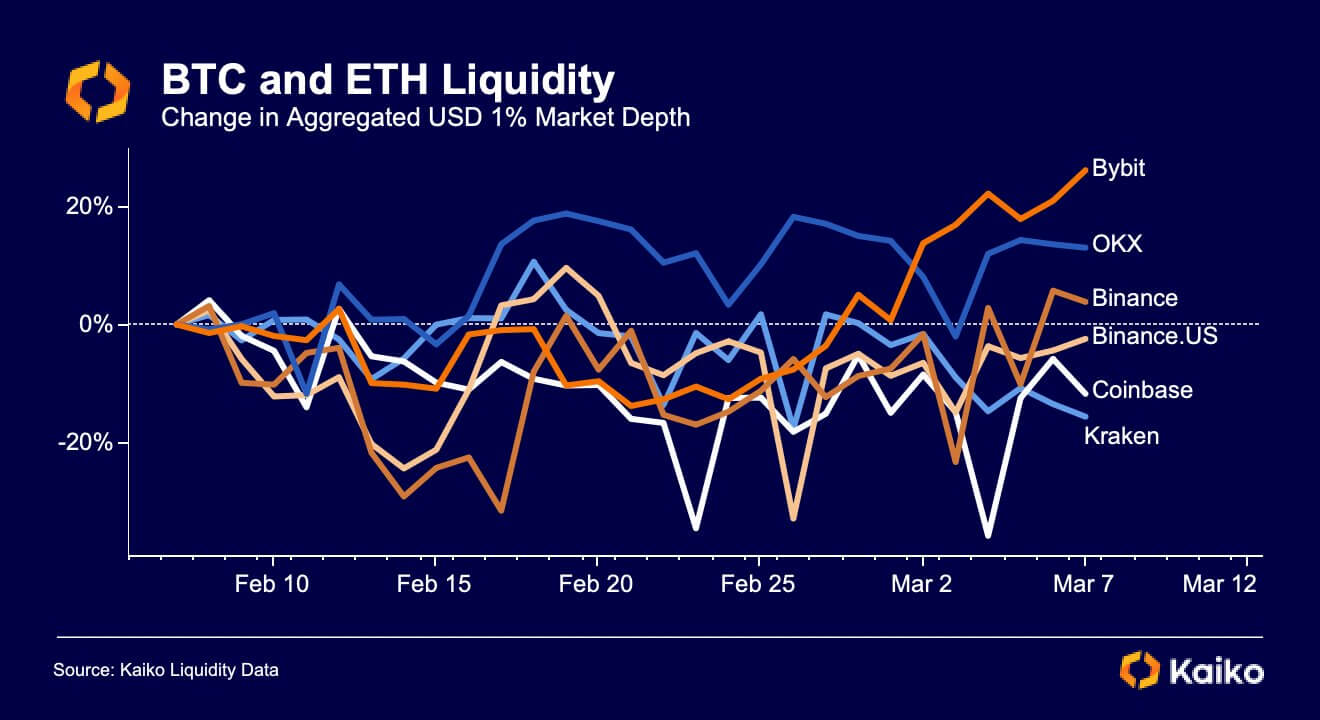
The crypto market’s liquidity measures how the market can absorb large buy and sell orders without significantly affecting prices.
The on-chain data aggregator noted that the USD’s liquidity level was close to that of Binance USD (BUSD) stablecoin. However, BUSD’s liquidity for its top pairs had dropped by as much as 40% when New York’s financial regulator ordered the asset’s issuer Paxos to stop further mints.
While BUSD’s liquidity level has begun to improve slightly, Kaiko said the Silvergate news was “weighing on USD pairs,” bringing it closer to the level of the embattled stablecoin.
Meanwhile, the liquidity drop across US exchanges appears to have contributed to ETH and BTC’s slight negative market depth over the period.
The significant USD liquidity decline shows Silvergate’s role in connecting the traditional financial system and the crypto industry.
At its peak, the bank’s Silvergate Exchange Network (SEN) reportedly processed over $219 billion in transfers and generated $9.3 million in revenue during the fourth quarter of the 2021 market rally.
Major crypto firms, including Coinbase, Gemini, Paxos, and Circle, used the services. Unfortunately, these institutions were forced to drop the bank due to concerns about its ability to continue operating.
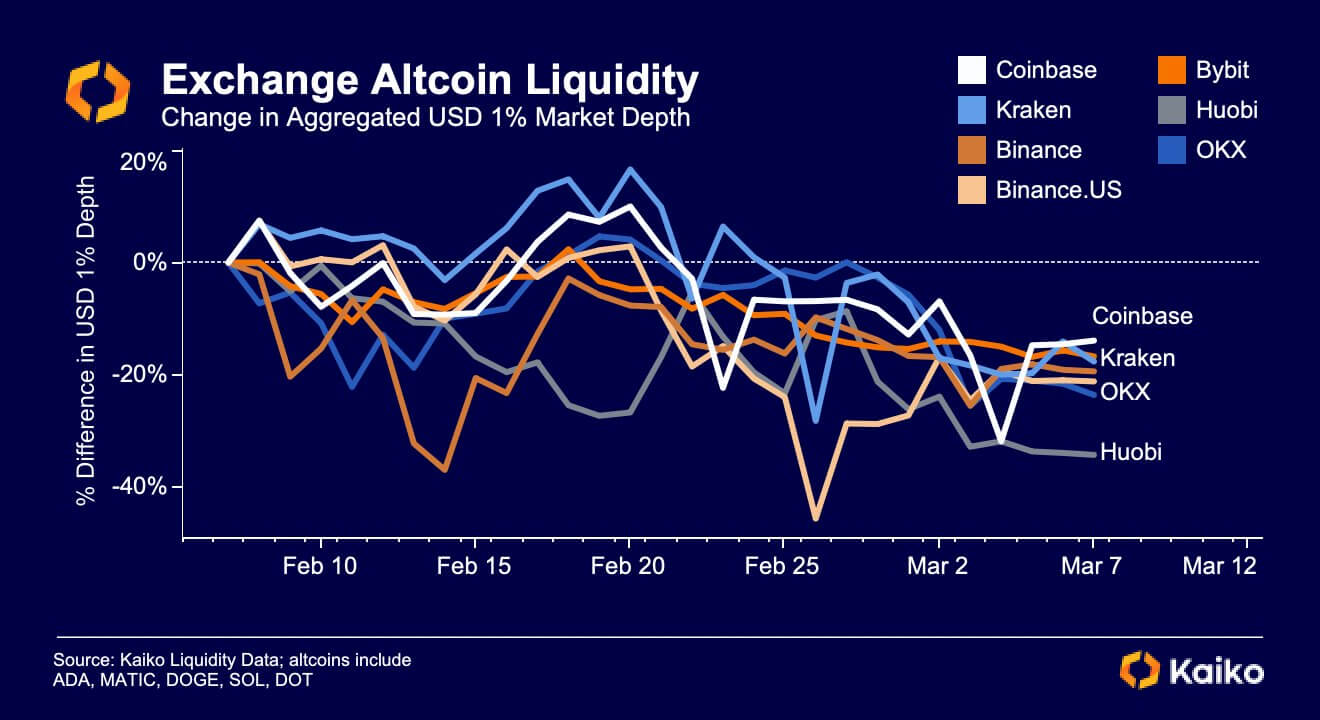
Meanwhile, the worsening liquidity appears to affect altcoins across several exchanges.

Kaiko’s data showed that several exchanges had lost more than 15% of their market depth for altcoins, like Cardano’s ADA, Polygon’s MATIC, Dogecoin’s DOGE, Solana’s SOL, and Polkadot’s DOT during the last 30 days.
According to the data, the least affected exchange was Coinbase, whose depth for these crypto-assets dropped 14%, while others like Bybit and Kraken lost 17% each. Binance and its US subsidiary shed 20%, respectively, while Huobi is down 35%.
While USD’s liquidity has been dropping against the crypto market, the European Union’s Euro has been gaining ground against Bitcoin, according to Kaiko data.
Kaiko pointed out that the Euro’s volume relative to USD has nearly doubled since FTX’s collapse in November 2022. According to the firm, Euro’s volume rose to 16% from 9% for BTC markets.
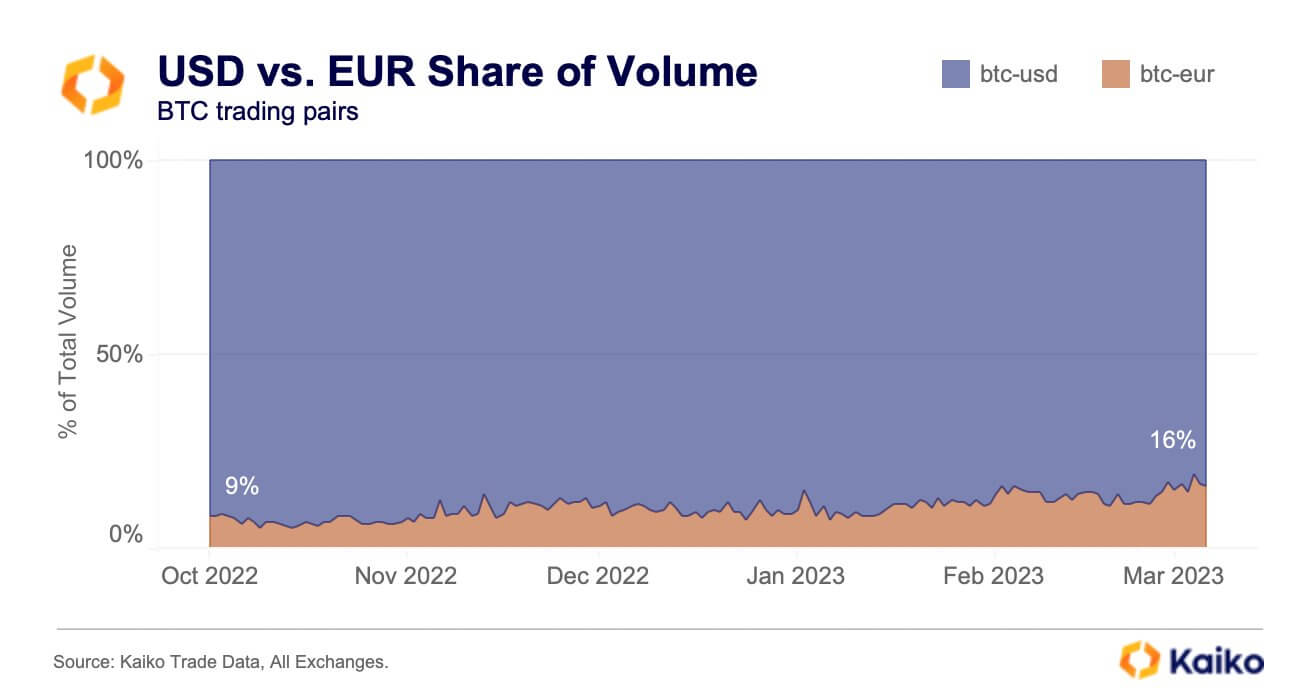
The increased Euro volume has coincided with the rise of Euro-backed stablecoins. As a result, the top two stablecoin issuers, Tether and Circle, have introduced stablecoins backed by the Euro to gain market share.
Stablecoin News