New insight into a vital cerebral pathway has explained how
some patients in a vegetative state are aware despite appearing to be
unconscious and being behaviourally unresponsive.
The findings, published in JAMA Neurology, identify
structural damage between the thalamus and primary motor cortex as the
obstacle between covert awareness and intentional movement.
The team of researchers hope that their study, the first to
understand the phenomenon, will pave the way for the development of
restorative therapies for thousands of patients.
Dr. Davinia Fernández-Espejo, from the University of Birmingham,
explained, “A number of patients who appear to be in a vegetative state
are actually aware of themselves and their surroundings, able to
comprehend the world around them, create memories and imagine events as
with any other person.”
“However, before we take the crucial step of developing targeted
therapies to help these patients, we needed to identify the reason for
the dissociation between their retained awareness and their inability to
respond with intentional movement.”
“A Thalamocortical Mechanism for the Absence of Overt Motor Behavior in
Covertly Aware Patients” by Davinia Fernández-Espejo, PhD; Stephanie
Rossit, PhD; and Adrian M. Owen, PhD in JAMA Neurology. Published online October 19 2015 doi:10.1001/jamaneurol.2015.2614
Image of brain showing the location of the thalamus (green) and primary
motor cortex (blue). Credit: University of Birmingham/Dr. Davinia
Fernández-Espejo.
Enjoy your bacon sandwich, while we walk you through the facts and fictions of what science can – and maybe someday, will – do to help people lose weight safely.
Why was 2015′s “Super Blood Moon Eclipse” so special? And how do lunar eclipses work in the first place? Find out on this week’s It’s Okay To Be Smart!
If you enjoyed this video and want to see more, make sure to subscribe on YouTube! Thanks for being curious and awesome.
Stacey Boland works at NASA’s Jet Propulsion Laboratory (JPL) on
missions that use remote sensing instruments for Earth observation. From space, we can learn so much about our
changing environment here on Earth.
Maximizing science research
requires finding creative and cost effective ways to do it! Her team developed the ISS-RapidScat instrument
using left over equipment NASA had in storage from a program launched in the
1990’s. ISS-RapidScat is an external
payload mounted to the outside of the Columbus module, part of
the International
Space Station. ISS-RapidScat measures ocean wind speed and direction to
help track tropical cyclones and hurricanes. Stacey’s team was able to get a
functioning piece of hardware for about a tenth the cost of a traditional
“small” Earth science mission.
Stacey said, “It wasn’t easy,
but it was worth it! Working in the
space program doesn’t require perfection - but it does require passion and hard
work! We work as a team here at NASA and
everyone’s role is important. We rely on
each other to do our best, regardless of what part of the mission is
“ours.” All the parts need to
work together for it to be a success and that takes teamwork and good
communication!”
Stacey’s story represents how being creative in the NASA
Village can really make a difference!
Where did Stacey get her hunger
for space? “When I was growing up, my
dad and I would learn about each shuttle mission and then watch launches on TV
together. It was fun learning about science and exploration together. Now, as a
parent, I’m continuing on that tradition with my son”
“I was able to watch the
SpaceX-4 launch in person with my mom, dad, husband, and son”, Stacy said. “It
was absolutely incredible to share that experience with them. My son still talks about it and has been
practicing drawing rockets ever since.
He often asks when we can go back to Florida to see another one!”
Experiencing a rocket launch in
person is amazing. Feeling the sound
waves from the engines push against your body is quite a rush. And when it is hardware you helped create, on its
way into space, it makes that experience even more special.
Next time on the NASA Village… A
visit to the NASA Village inspires a lifelong career.
Do you want more stories? Find our NASA
Villagers here!
What you are seeing in this photo is a bee voiding water. Voiding water is common in Bumble bees and honey bees as they have a high metabolic water production. Nectar has a high water content which not only provides the sugar necessary for activity but also an excess of water. This excess water needs to be removed in order to maintain a balanced water budget.
Less than 1% of girls study Computer Science. Let’s change that.
By 2017, the app market will be valued at $77 Billion. Over 80% of these developers are male. The Technovation Challenge aims to change that by empowering girls worldwide to develop apps for an international competition. From rural Moldova to urban Brazil to suburban Massachusetts, CODEGIRL follows teams who dream of holding their own in the world’s fastest-growing industry. The winning team gets $10K to complete and release their app, but every girl discovers something valuable along the way.
Join high school-aged girls from around the world as they try to better their community through technology and collaboration in this thrilling, heartfelt documentary. CODEGIRL was made to inspire girls everywhere to pursue a career in programming, empowering them with the knowledge that girls just like them from all over the globe are learning to code and developing applications that improve the world in which they live.
Presented and sponsored by Google’s Made with Code initiative, you can watch CODEGIRL for FREE, exclusively on YouTube through November 1-5!
Robert Shurney (1921-2007) Dr. Robert Shurney was a physicist from Tennessee State University, who worked at NASA. As a Marshall Space Flight Center engineer, he accomplished several major and significant tasks for NASA, including designing the tires for the moon buggy used during the Apollo 15 mission in 1972. His ingenious design used wire mesh …
With astronauts living and working aboard the International Space Station, we’re learning a great deal about creating and testing critical systems, maintaining efficient communications and protecting the human body during a deep space mission. While these are critical to our journey to Mars, it is important to also note all the ways in which research conducted and technology tested aboard the orbiting laboratory help us here on Earth.
Here are 15 ways the space station is benefiting life on Earth:
1. Commercializing Low-Earth Orbit
An exciting new commercial pathway is revolutionizing and opening access to space, fostering America’s new space economy in low-Earth orbit. For the first time, the market is expressing what research can and should be done aboard the microgravity laboratory without direct government funding. Our move to purchase commercial cargo resupply and crew transportation to the space station enables U.S. businesses to develop a competitive capability they also can sell as a service to others while freeing our resources for deep space exploration. Private sector participation provides a new model for moving forward in partnership with the government.
2. Supporting Water Purification Efforts Worldwide
Whether in the confines of the International Space Station or a tiny hut village in sub-Saharan Africa, drinkable water is vital for human survival. Unfortunately, many people around the world lack access to clean water. Using technology developed for the space station, at-risk areas can gain access to advanced water filtration and purification systems, making a life-saving difference in these communities. The Water Security Corporation, in collaboration with other organizations, has deployed systems using NASA water-processing technology around the world.
3. Growing High-Quality Protein Crystals
There are more than 100,000 proteins in the human body and as many as 10 billion in nature. Every structure is different, and each protein holds important information related to our health and to the global environment. The perfect environment in which to study these structures is space. Microgravity allows for optimal growth of the unique and complicated crystal structures of proteins leading to the development of medical treatments. An example of a protein that was successfully crystallized in space is hematopoietic prostaglandin D synthase (H-PGDS), which may hold the key to developing useful drugs for treating muscular dystrophy. This particular experiment is an example of how understanding a protein’s structure can lead to better drug designs. Further research is ongoing.
4. Bringing Space Station Ultrasound to the Ends of the Earth
Fast, efficient and readily available medical attention is key to survival in a health emergency. For those without medical facilities within easy reach, it can mean the difference between life and death. For astronauts in orbit about 250 miles above Earth aboard the International Space Station, that problem was addressed through the Advanced Diagnostic Ultrasound in Microgravity (ADUM) investigation. Medical care has become more accessible in remote regions by use of small ultrasound units, tele-medicine, and remote guidance techniques, just like those used for people living aboard the space station.
5. Improving Eye Surgery with Space Hardware
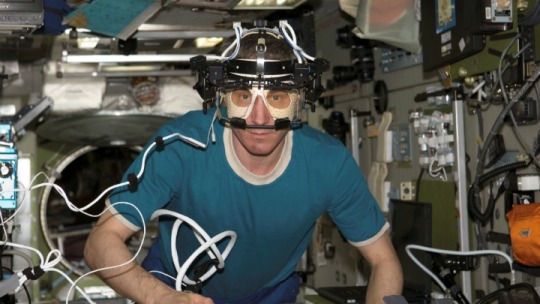
Laser surgery to correct eyesight is a common practice, and technology developed for use in space is now commonly used on Earth to track a patient’s eye and precisely direct the laser scalpel. The Eye Tracking Device experiment gave researchers insight into how humans’ frames of reference, balance and the overall control of eye movement are affected by weightlessness. In parallel with its use on the space station, the engineers realized the device had potential for applications on Earth. Tracking the eye’s position without interfering with the surgeon’s work is essential in laser surgery. The space technology proved ideal, and the Eye Tracking Device equipment is now being used in a large proportion of corrective laser surgeries throughout the world.
6. Making Inoperable Tumors Operable with a Robotic Arm
The delicate touch that successfully removed an egg-shaped tumor from Paige Nickason’s brain got a helping hand from a world-renowned arm—a robotic arm, that is. The technology that went into developing neuroArm, the world’s first robot capable of performing surgery inside magnetic resonance machines, was born of the Canadarm (developed in collaboration with engineers at MacDonald, Dettwiler, and Associates, Ltd. [MDA] for the U.S. Space Shuttle Program) as well as Canadarm2 and Dextre, the Canadian Space Agency’s family of space robots performing the heavy lifting and maintenance aboard the International Space Station. Since Nickason’s surgery in 2008, neuroArm has been used in initial clinical experience with 35 patients who were otherwise inoperable.
7. Preventing Bone Loss Through Diet and Exercise
In the early days of the space station, astronauts were losing about one-and-a-half percent of their total bone mass density per month. Researchers discovered an opportunity to identify the mechanisms that control bones at a cellular level. These scientists discovered that high-intensity resistive exercise, dietary supplementation for vitamin D and specific caloric intake can remedy loss of bone mass in space. The research also is applicable to vulnerable populations on Earth, like older adults, and is important for continuous crew member residency aboard the space station and for deep space exploration to an asteroid placed in lunar orbit and on the journey to Mars.
8. Understanding the Mechanisms of Osteoporosis
While most people will never experience life in space, the benefits of studying bone and muscle loss aboard the station has the potential to touch lives here on the ground. Model organisms are non-human species with characteristics that allow them easily to be reproduced and studied in a laboratory. Scientists conducted a study of mice in orbit to understand mechanisms of osteoporosis. This research led to availability of a pharmaceutical on Earth called Prolia® to treat people with osteoporosis, a direct benefit of pharmaceutical companies using the spaceflight opportunity available via the national lab to improve health on Earth.
9. Developing Improved Vaccines
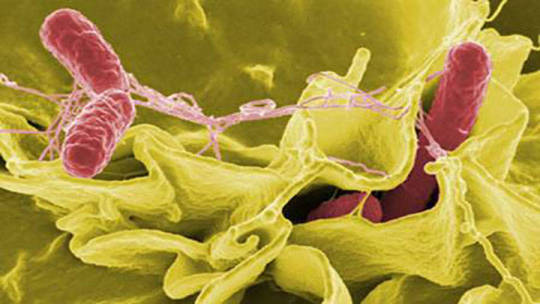
Ground research indicated that certain bacteria, in particular Salmonella, might become more pathogenic (more able to cause disease) during spaceflight. Salmonella infections result in thousands of hospitalizations and hundreds of deaths annually in the United States. While studying them in space, scientists found a pathway for bacterial pathogens to become virulent. Researchers identified the genetic pathway activating in Salmonella bacteria, allowing the increased likelihood to spread in microgravity. This research on the space station led to new studies of microbial vaccine development.
10. Providing Students Opportunities to Conduct Their Own Science in Space
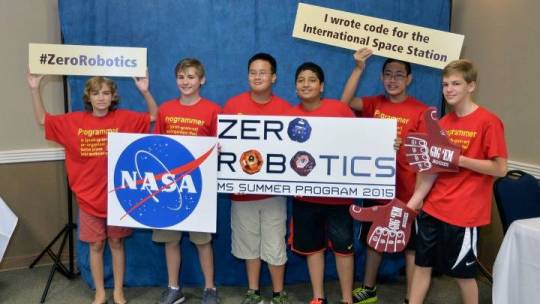
From the YouTube Space Lab competition, the Student Spaceflight Experiments Program, and SPHERES Zero Robotics, space station educational activities inspire more than 43 million students across the globe. These tyFrom the YouTube Space Lab competition, the Student Spaceflight Experiments Program, and SPHERES Zero Robotics, space station educational activities inspire more than 43 million students across the globe. These types of inquiry-based projects allow students to be involved in human space exploration with the goal of stimulating their studies of science, technology, engineering and mathematics. It is understood that when students test a hypothesis on their own or compare work in a lab to what’s going on aboard the space station, they are more motivated towards math and science.
11. Breast Cancer Detection and Treatment Technology
A surgical instrument inspired by the Canadian Space Agency’s heavy-lifting and maneuvering robotic arms on the space station is in clinical trials for use in patients with breast cancer. TheImage-Guided Autonomous Robot (IGAR) works inside an MRI machine to help accurately identify the size and location of a tumor. Using IGAR, surgeons also will be able to perform highly dexterous, precise movements during biopsies.
12. Monitoring Water Quality from Space
Though it completed its mission in 2015, the Hyperspectral Imager for the Coastal Ocean (HICO) was an imaging sensor that helped detect water quality parameters such as water clarity, phytoplankton concentrations, light absorption and the distribution of cyanobacteria. HICO was first designed and built by the U.S. Naval Research Laboratory for the Office of Naval Research to assess water quality in the coastal ocean. Researchers at the U.S. Environmental Protection Agency (EPA) took the data from HICO and developed a smartphone application to help determine hazardous concentrations of contaminants in water. With the space station’s regular addition of new instruments to provide a continuous platform for Earth observation, researchers will continue to build proactive environmental protection applications that benefit all life on Earth.
13. Monitoring Natural Disasters from Space
An imaging system aboard the station, ISS SERVIR Environmental Research and Visualization System (ISERV), captured photographs of Earth from space for use in developing countries affected by natural disasters. A broader joint endeavor by NASA and the U.S. Agency for International Development, known as SERVIR, works with developing nations around the world to use satellites for environmental decision-making. Images from orbit can help with rapid response efforts to floods, fires, volcanic eruptions, deforestation, harmful algal blooms and other types of natural events. Since the station passes over more than 90 percent of the Earth’s populated areas every 24 hours, the ISERV system was available to provide imagery to developing nations quickly, collecting up to 1,000 images per day. Though ISERV successfully completed its mission, the space station continues to prove to be a valuable platform for Earth observation during times of disaster.
14. Describing the Behavior of Fluids to Improve Medical Devices
Capillary Flow Experiments (CFE) aboard the space station study the movement of a liquid along surfaces, similar to the way fluid wicks along a paper towel. These investigations produce space-based models that describe fluid behavior in microgravity, which has led to a new medical testing device on Earth. This new device could improve diagnosis of HIV/AIDS in remote areas, thanks in part to knowledge gained from the experiments.
15. Improving Indoor Air Quality
Solutions for growing crops in space now translates to solutions for mold prevention in wine cellars, homes and medical facilities, as well as other industries around the world. NASA is studying crop growth aboard the space station to develop the capability for astronauts to grow their own food as part of the agency’s journey to Mars. Scientists working on this investigation noticed that a buildup of a naturally-occurring plant hormone called ethylene was destroying plants within the confined plant growth chambers. Researchers developed and successfully tested an ethylene removal system in space, called Advanced Astroculture (ADVASC). It helped to keep the plants alive by removing viruses, bacteria and mold from the plant growth chamber. Scientists adapted the ADVASC system for use in air purification. Now this technology is used to prolong the shelf-life of fruits and vegetables in the grocery store, and winemakers are using it in their storage cellars.
For more information on the International Space Station, and regular updates, follow @Space_Station on Twitter.
This effect is a result of what’s known as Kelvin-Helmholtz instability. Put very simply, this is something that happens when you have layers of air on top of each other that are moving at different velocities.
That occurs more than you might think, seeing as air behaves in very different ways depending on its temperature, humidity, and the surface it’s travelling over.
So now imagine those two different layers of air as two different fluids. Instead of never interacting, the layers are going to try to mix where they meet.
When the top layer of air is moving faster than the bottom layer, this results in that slower air being scooped up, creating a wave-like structure that repeats over and over again until the system normalises itself.
And when a cloud just happens to be caught between those two layers, it results in the beautiful wave-like formation you see above. Sadly, however, these clouds never hang around long, as natural turbulence will eventually collapse the wave.
What’s better than studying the intact human body? Exploring anatomical details and relationships in an exploded view!
Now available in the BioDigital Human, you can separate the parts of any view, from the bones of the skull
to the muscles and vessels of the heart.
The “Exploded View” feature is available on the rightmost side of the edit bar.
You’ll retain full interactivity while in exploded mode, meaning you can still zoom, pan, rotate, and select different objects. Exploded view works in our detailed medical conditions as well.
Login to the BioDigital Human and explore different “parts” of your body today.
“Perfect graphs are, by definition, colorable with the most limited palette possible. When coloring a graph, every node in a mutually connected cluster, or “clique,” must receive a distinct color, so any graph needs at least as many colors as the number of nodes in its largest clique. In most graphs, you need many more colors than this. But in perfect graphs, you do not. As the French graph theorist Claude Berge defined them in 1961, perfect graphs require a number of colors exactly equal to the size of their largest clique. The “chromatic number” must also equal the “clique number” for every subset of a perfect graph formed by deleting some of its nodes. This perfection rarely arises in the real world, but the property has made perfect graphs much easier to analyze and prove theorems about than their imperfect counterparts.”