

4 years ago
Currents in Biology
@currentsinbiology
“Somewhere, something incredible is waiting to be known.” ― Carl Sagan
Photo

Hummingbirds can count their way to food
Tiny, feisty rufous hummingbirds are known for their long migrations, which take them up and down the length of North America each year. Now, they have a new claim to fame: They can keep track of particularly juicy flowers depending on where they appear—first, second, or even fourth—in a line-up of blooms. Although this understanding of “numerical order” may sound simple, it’s a complex skill that may help hummingbirds remember the easiest routes between nectar-rich flowers. It’s also the first time researchers have seen the ability in a wild vertebrate.

Video
How flying snakes stay stable while gliding through the air
Flying snakes glide through the air, flattening their bodies to provide lift. But as they glide they seem to swim, undulating their bodies from side to side. Now a team in the United States has used motion capture technology to study snake gliding in precise detail. Their models reveal that undulation is vital for the snake’s stability as they glide from branch to branch.
Photo
‘Ghost fleas’ bring toxic mercury up from the depths of prairie lakes
How toxic mercury moves through the environment—and accumulates in the fish that people eat—has been known for decades. Now, scientists have discovered an unexpected way that the neurotoxin circulates in lakes, hitching a late-night ride inside small predatory crustaceans dubbed “ghost fleas.” The finding helps explain why some lake fish contain surprising amounts of mercury. It also suggests researchers who sample lakes only during the day might be missing important clues to how those ecosystems work.

Photo
’Like Poking a Beehive’: The Worrisome Link Between Deforestation And Disease
“When you disturb a forest, it actually upsets, if you want, the balance of nature, the balance between pathogens and people.”

Photo
Deep-sea currents are behind the ocean’s thickest piles of microplastics
They found an average of 41 pieces in each spoonful of sediment from continental shelves. That number dropped to just nine pieces deeper down on the continental slope. But when scientists sampled piles of sediment that build up in the deep ocean, adjacent to fast-flowing currents, they found 190 pieces of microplastics per spoonful of sediment, the highest concentration of microplastics from the sea floor to date, they report this month in Science.
That amount—which adds up to 1.9 million pieces of microplastic per square meter—is likely dumped by the fast-flowing currents, meaning deep-sea circulation plays a role in where microplastics are deposited. These currents also bring vital nutrients and oxygen to the sea floor, scientists say, suggesting microplastic hot spots could overlap with areas rich in biodiversity. As researchers embark on expeditions to survey different areas on the sea floor—like submarine canyons and fans—they may just find the next hot spot.

Photo
Great! They’ve solved the dying bee problem. :(
Blowing bubbles: Soapy spheres pop pollen on fruit trees
Japanese researchers have succeeded in fertilising pear trees using pollen carried on the thin film of a soap bubble.
They’ve been searching for alternative approaches to pollination, because of the decline in the number of bees worldwide.
When fired from a bubble gun, the delicate soapy spheres achieved a success rate of 95%.
The researchers are now testing drones that fire bubbles for pollination.

Photo
Fighting fish synchronize their moves—and their genes
Okada and colleagues videotaped more than a dozen hours of fights between 17 pairs of fish and then analyzed what happened—and when—in each fight. The longer the fight, the more the fish synchronize their behavior, timing their circling, striking, and biting more than anyone had ever realized, the researchers report today in PLOS Genetics.

Photo
Like humans, these big-brained birds may owe their smarts to long childhoods
Human beings typically don’t leave the nest until well into our teenage years—a relatively rare strategy among animals. But corvids—a group of birds that includes jays, ravens, and crows—also spend a lot of time under their parents’ wings. Now, in a parallel to humans, researchers have found that ongoing tutelage by patient parents may explain how corvids have managed to achieve their smarts.

Photo
Millions of periodical cicadas to emerge in parts of US
After spending 17 years underground, millions of cicadas will be emerging in parts of the United States.
Periodical cicadas are expected to come out in early summer across southwest Virginia, parts of North Carolina, and in West Virginia.
As many as 1.5 million of the insects can emerge per acre of land.
While they are some of the longest-lived insects in the world, periodical cicadas spend almost their entire lives underground as what entomologists call “nymphs”.
They live in the soil and feed on tree roots for periods of either 13 or 17 years depending on the species, according to Virginia Tech university.

Photo
First U.S Woman To Walk In Space Dives To Deepest Point On Earth
“As a hybrid oceanographer and astronaut this was an extraordinary day, a once in a lifetime day.”

Photo
Epic 7,500-mile cuckoo migration wows scientists
Using a satellite tag, scientists have monitored a cuckoo that has just flown more than 7,500 miles (12,000km) from southern Africa to its breeding ground in Mongolia.
The bird has survived ocean crossings and high winds after traversing 16 countries.

Photo
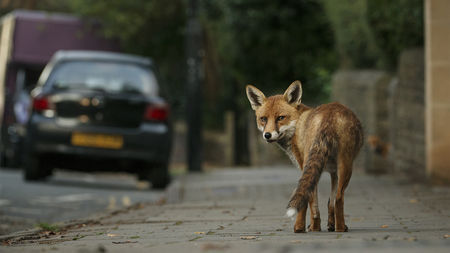
Urban foxes may be self-domesticating in our midst
In a famous ongoing experiment started in 1960, scientists turned foxes into tame, doglike canines by breeding only the least aggressive ones generation after generation. The creatures developed stubby snouts, floppy ears, and even began to bark.
Now, it appears that some rural red foxes in the United Kingdom are doing this on their own. When the animals moved from the forest to city habitats, they began to evolve doglike traits, new research reveals, potentially setting themselves on the path to domestication.
Video

Image of the Week – June 8, 2020
CIL:12375 - http://cellimagelibrary.org/images/12375
Description: Movie showing the dynamics of kinetchore microtubules during meiosis II in primary spermatocytes of the crane-fly Nephrotoma suturalis that were experimentally flattened. Time-lapse polarization microscopy using a Nikon Microphot SA, equipped for liquid crystal polarized light microscopy (LC-PolScope, CRi, Woburn Massachusetts) 60x/1.4 PlanApo oil immersion objective, 1.4 NA oil imm. condenser, with 2.0x zoom lens. Images captured every 15 sec using a QImaging Retigo EXi CCD camera. Raw images were processed using 5-frame algorithm (Shribak and Oldenbourg, 2003). The time series used for the movie is included in this grouped set.
Authors: James R. LaFountain and Rudolf Oldenbourg
Licensing: Public Domain: This image is in the public domain and thus free of any copyright restrictions. However, as is the norm in scientific publishing and as a matter of courtesy, any user should credit the content provider for any public or private use of this image whenever possible.
Photo

Part 2 of the antibody testing graphics looks at how different types of antibody test work.
Larger image and PDF download (and a bit more detail on the current coronavirus antibody tests) in the accompanying post: https://ift.tt/378gzln https://ift.tt/3cFpYSV

Photo
SLOPPY SCIENCE 101! Do the work before you publish.
Two elite medical journals retract coronavirus papers over data integrity questions
“Our independent peer reviewers informed us that Surgisphere would not transfer the full dataset, client contracts, and the full ISO audit report to their servers for analysis as such transfer would violate client agreements and confidentiality requirements,” making the outside audit of the data impossible, the three co-authors wrote in the retraction statement. “Based on this development, we can no longer vouch for the veracity of the primary data sources.”

Photo
Can Mail Spread the Novel Coronavirus?
“People should not be concerned, she says. SARS-CoV-2 “is very short lived on porous surfaces,” such as cardboard and paper. Once outside the body, the virus is easily rendered non-infectious, because its fragile lipid envelope can be damaged or destroyed with alcohol, soap or ultraviolet light, she says. “The guts of the virus, the genome and the protein wrapping it will be exposed,” which renders it unable to reproduce, she says.
“

Photo
Remains of 60 Mammoths Discovered in Mexico
So far, researchers have found no signs of the animals having been butchered by humans, but, per the statement, Sánchez Nava says the possibility that humans took advantage of the heavy animals once they got stuck in the mud has not been ruled out.

Photo
Mighty seals humbled by prey that flickers and flashes
When the two seals chased flashing prey, the pursuit took longer than did attempts to capture non-flashing prey. This suggests that flashing prey are tougher to capture, possibly because the bursts of light dazzle the seals.

Photo
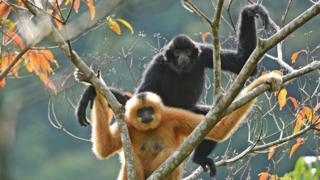
Conservation: Glimmer of hope for world’s rarest primate
The discovery of a new breeding pair raises hope for the survival of the world’s rarest primate, the Hainan Gibbon.
Ravaged by deforestation and poaching, the ape now lives only in a patch of forest on China’s Hainan island.
In the 1950s, there were an estimated 2,000 left in the world, but numbers fell to fewer than 10 in the 1970s.
The latest census shows numbers have tripled to more than 30 gibbons, living in five separate family groups.
Photo
Blue Bee Feared to Be Extinct Is Found in Florida
As soon as the blue calamintha bee arrived on the scene, scientists worried it might be gone for good.
The indigo insect was last spotted in central Florida in 2016, five years after it was first identified. But this spring, just as Americans began to hunker down because of the COVID-19 pandemic, the rare blue bees, known scientifically as Osmia calaminthae, were rediscovered in the same region foraging on Ashe’s calamint, a dainty violet flower that blooms in certain scrub habitats.

Photo
These bacteria have adapted to life in your nose—and that may be good news
Like a sprawling urban city, certain neighborhoods of the human body support different communities of microbes. And many of these are good guys; the microbes in our gut help us digest food, for example, whereas those on our tongue and skin can guard against invading pathogens. Now, researchers have found beneficial bacteria in our nose as well. This “nasal microbiome” may guard against chronic sinus inflammation or even allergies.

Photo
World’s deepest octopus captured on camera
The deepest ever sighting of an octopus has been made by cameras on the Indian Ocean floor.
The animal was spotted 7,000m down in the Java Trench - almost 2km deeper than the previous reliable recording.
Researchers, who report the discovery in the journal Marine Biology, say it’s a species of “Dumbo” octopus.

Photo
The Search for Life on Kangaroo Island
THE GREAT KOALA RESCUE OPERATION
While the bushfires all over Australia were horrific, burning more than 16 million acres—nearly eight times the area lost to fire in Brazil’s Amazon basin in 2019—people around the world focused on Kangaroo Island because of the relative scale of the fires, which consumed close to half the island, as well as the concentrated death and suffering of the island’s abundant wildlife, including wallabies, kangaroos, possums and koalas.

Photo
How Venus flytraps evolved their taste for meat
How does a plant develop a taste for flesh? In the play Little Shop of Horrors, all it takes is a drop of human blood. But in real life, it takes much more. Now, a study of three closely related carnivorous plants suggests dextrous genetic shuffling helped them evolve the ability to catch and digest protein-rich meals.

Link
Elephants flee to survive coronavirus starvation
Elephants flee to survive coronavirus starvation
www.bbc.com
Photo

A beautiful undersea flower? No – this is a cockscomb nudibranch, a type of sea slug! Look closely and you can see its digestive tract through its translucent body.
This small nudibranch was photographed by Robin Agarwal at Monterey Harbor in Monterey Bay National Marine Sanctuary, and was a submission for the 2019 Get Into Your Sanctuary Photo Contest. The 2020 photo contest is now open! Learn how to submit your photos at https://sanctuaries.noaa.gov/photo-contest.html.
(Photo: Robin Agarwal. Image description: A translucent white sea slug with bright blue and orange cerata.)

Photo
Covid recovery could ‘tip the balance’ for nature
Environmental scientists have called for the conservation of nature to be at the centre of the economic recovery from the coronavirus pandemic.
With countries still ensnared by the crisis, scientists have urged governments to make plans that “safeguard biodiversity and human health” as they rebuild.
“How we emerge from lockdowns,” they say, “will drive a new world economy.”
This is likely to have lasting effects on global biodiversity, the Australian authors argue


Link
National parks hope visitors comply with virus measures
Visitors to Yellowstone National Park often leave common sense and situational awareness at home, as those examples in the past year show.

Photo
Hungry bumble bees make plants flower early by cutting holes in their leaves
When bumble bee queens emerge from hibernation, they need to gather pollen and nectar to start their new colonies. If they wake up too soon, there may not be enough flowers in bloom. Now, researchers have discovered the bees have a way to order some fast food: They nibble holes in leaves, spurring plants to blossom weeks ahead of schedule.
