Even if you can conclusively prove that a given group is more privileged than you are, that still does not entitle you to single out a random member of said group to harass or abuse. Nor does it entitle you to police the language the more privileged group uses to describe their own lived experiences with marginalisation and systemic issues they face.
Where I live, well educated white cis gay men tend to be more privileged in some workplaces compared to equally well educated white cis women. Regardless, white cis gay men are certainly more privileged than the average trans person. That does not mean that I would under any circumstances be okay with someone bullying a cis man because he is gay or people think he is. Nor would I tell him to shut up when he discusses the marginalisation he and fellow gay men experience.
There are no acceptable targets. Stop abusing your fellow humans. No, your marginalised status does not mean that you are incapable of being abusive or oppressive yourself.

You are not the Language Police
You do not get to dictate what language members of other marginalised groups are allowed to use when they discuss their own lived experience with oppression and other marginalisation. Doing so is oppressive behaviour. Please, stop.
No, this behaviour does not become magically alright by claiming that your own identity is more oppressed than the group you are trying to police. The fact that you feel entitled to repeatedly go up to these people and tell them what words they can and cannot use for their own experiences strongly implies that you are not less privileged than them and that you know this very well.
This particularly applies to adjacent groups that you share an umbrella with. Examples include most instances of respectability politics: men of from a given marginalised ethnic group who try to silence or police women and LGBTQ people from their own ethnic group. Feminist groups where white straight women try to silence women of colour and queer women. Within the LGBTQ community, it is cis gays, lezzes and bis trying to silence or police trans people and queers. Within the trans community, it is talking over and trying to silence other subcategories of trans people one does not belong to and disregarding intersections such as race, class and disability within one’s own group.

“I think that many people relate to being hunted, to being ostracised, to being condemned for nothing more than the crime of being themselves. But those same people create art and literature and healing, and humanity cannot thrive without them.”
C.G. Aubrey

La problématique des enfants des rues en Haïti : enjeux humanitaires, impacts socio-économiques et perspectives
Télécharger l’article [Download]
Résumé
Cet article examine la marginalisation des enfants des rues en Haïti dans une perspective socio-économique, démontrant qu’elle représente un passif national sous-estimé. S’inscrivant dans une méthodologie mixte combinant l’analyse économique des coûts de l’inaction et l’évaluation des rendements démographiques potentiels, l’étude quantifie les externalités…

Black intersex people are among the most marginalized. LGBTQ+ people are part of the problem

One thing I’d do with a billion dollars is I’d create a stipend for people with disabilities who are struggling with their education as a result of said disability. I’d make the application process easy and neurodiversity friendly

This Exhibition Breathes Life Into The Forgotten Histories of The Black Community
The limitation or erasure of Black identity in the Western art world is not a new discovery; it has existed for millennia. It is only in recent decades that their representation and their right to expression have become more mainstream and widely accepted. Like the older art forms, photography is no different. Even today, we continue to fight an everyday battle to credit the contribution of the…
This Exhibition Breathes Life Into The Forgotten Histories of The Black Community

Still abused, still ignored, still marginalised, even in the past when I did follow their rules in order to fit in. Still remembered only to be a punch bag or a doormat. But for some reason I still need to worry about how I live, dress, look, eat, about my hobbies and interests, my ideas and beliefs, about my whole being otherwise “people will talk”.
I wonder if those people who will talk will ever notice me and be happy when I achieve something and help me when I need help.
Guess what. NO THEY WILL NOT. They haven’t done it for 24 years now. They were jealous with my achievements and always absent or judgemental when I didn’t meet their expectations or when I wanted to kill myself. So naaah, I don’t expect them to do it now.
So, I keep doing my thing and IDGASF about “the people who will talk”.
If they choose to be ignorant and make assumptions instead of just ask me questions/ clarifications, it’s not my problem.
If they choose to be crybullies in case we disagree instead of being civilised, it’s not my problem.
If they get mad at me for not becoming a copy of themselves, it’s not my problem.
If they get frustrated at me for not becoming a puppet it’s not my problem.
If they get jealous of me, it’s not my problem
In general, their gossiping is not my problem. If they gossip, they probably have boring lives. I’m not gonna have a boring life and I’m not planning to lose myself again in order for them to be satisfied. BECAUSE THEY WILL NOT BE SATISFIED. I tried that. I was still treated like s***.
Leave me alone, for goodness sake.
Anyone else who was that kid who would always get picked last in team games or sit alone in the bus during school or camp trips? Anyone else feeling as if the above is some kind of curse that is chasing them up to this day?
It’s the “sitting alone in the double seat in the bus” kind of marginalisation as I call it.

Tribal communities face marginalisation and oppression on multiple fronts — in terms of their lands, their forests, their access to basic services, and overall discrimination. However, government policy has not treated any of these as priorities. In the case of forest and land rights, it has been actively undermining the rights of these communities. This needs to stop if genuine development or empowerment is to take place.

i think it’s so important to remember that a lack of privilege doesn’t strip someone of their individuality. coming from a society that is characterized by rampant socio-economic inequality, i am tired of this one-dimensional representation. people who are economically or socially marginalised, people of colour - why is their ‘legitimacy’ conditional to them fitting certain euro-centric models of acceptability?!

Community threatens to shut down oil export terminal over marginalisation
Community threatens to shut down oil export terminal over marginalisation

The suspended 1,300 civil servants in Delta State, who were disengaged in 2015, have once again appealed to Governor Ifeanyi Okowa to reabsorb them for the sake of equity, as those employed were not part of those affected in the purge.
The appeal, in a statement signed by Chairman, Suspended Civil Servants, Erhadje Clement and Secretary, Asini Victor, was predicated on the premise that a nine-man…

Buhari addressing marginalisation’

The call for restructuring will soon end because President Muhammadu Buhari is already addressing issues that led to it, a Lagos lawmaker, Jude Idimogu, has said. (more…)

I really like this article on Palestinian food because I feel like it cuts to the core of a lot of social issues.
‘We are not clowns in a circus for you to come and watch and make research notes about and then make your name from writing down our suffering.”
I think that applies to too many social and political issues that people with privilege and who are distant from the issues we talk about face. When we frame people in terms of issues, we can’t go far because it’s not enough to go ‘oh poor thing’ and then not do anything for the affected communities. Yes, awareness is important but our problem comes when we think complex social and historical issues can be solved with a conversation.
So many things are interlaced: politics, history, culture and they affect people’s lives in meaningful ways.
You really, really can’t talk about the future if you don’t know about the past, and you don’t talk to and engage with actual people on the ground.

A beautiful actress struggles to connect with her disfigured co-star on the set of a European auteur’s English-language debut.

Marginalisation:
Social exclusion, the process of being shut out (fully or partially) from the various social, economic, political or cultural systems that serve to aid the integration of a person into society.

Don’t forget that Marvel movies are only exploiting your need for representation for the capital gain of their corporate overlords. If Disney legitimately did care, they wouldn’t allow Fox News or the dozens of other companies they own to do what they do, and would not accept paychecks from hateful content, and wouldn’t engage in art theft like they’ve been exposed as doing. Any representation you see in Marvel or Disney or Pixar (!) or LucasArts (!!) movies you see are, very very likely, a greedy capitalist corpocracy exploiting the marginalised, yet again.

Stranger Danger
Nobody talks to anyone anymore. How can they when everybody is a threat to their lives?
Every morning I walk to the train station, taking the same route. I walk on my allocated
pavement, decaying and withering away with overuse, age and lack of maintenance, which is
only to be used by ‘my kind’. I follow the sea of grey bodies of sheep, towards my designated
train.
As I enter the cold concrete cell that is the train station, I am bombarded by constant reminders of the horrors within our society. The walls are layered with posters and screens that constantly remind the world about all the dangerous people who occupy it. I like to call it ‘The Wall of Marginalisation’. Every day ‘we’ are reminded by the ‘Holy Woman’ of how lucky we are to live in the ‘Haven Country’, and it’s all thanks to the ‘Holy law’ that “only people born in this country can live in it”.
I stare at all the ‘Quintessential’s’, who, like me, are gazing at the wall, however, unlike myself, they are thanking the ‘Holy house’ that they aren’t burdened with being born ‘Unorthodox’. Mesmerised by the blindness of the ‘Quinties’, I forget what I’m meant to be doing and realise I’m late for my train. I quickly run past ‘The Wall of Marginalisation’, down the stairs to the ‘Orthos’ platform, but as I arrive the train is just leaving. Deep down I know my search for another train is fruitless, and it’s then that I see another train arriving, (a Quinties train). I know it’s illegal for an Ortho to catch a Quinte’s train, but I remind myself that if I’m late, just once, I’ll be fired.
I decide to take my chances and confidently walk onto the train, heading straight to the back of the cart, burrowing my head into a book. I’ve never been on a Quintes train before and always wondered what it was like. It’s appearance from the outside isn’t dissimilar to my usual train, but on the inside, it is far more luxurious, with its matching seats and pristine white surfaces. I notice that everyone is at least one metre apart and no one is making eye contact; even the children’s heads are burrowed into their mothers’ laps.
After a few minutes, I relax and look up from my book, when I do I notice a small figure standing in front of me. A little girl who has been brave enough to venture a whole three steps away from her mother, whom I notice is absorbed by her newspaper, and I can guess what has enticed the little girl enough to get the courage to do so.
Her voice is like a scream, shattering the silence of the train when she asks me why my skin isn’t the same shade as her own. I smile at her curiosity and daring nature, but I don’t get a chance to respond before her mother reaches out for her, giving me a withering look that could turn flesh to stone. I hear her warn her daughter about ‘stranger danger’ and I think to myself;
“Well maybe some people are just nice.”
I don’t understood why the world lives with this paranoia and can’t help but think of the Holy Woman’s moto “Xenophobia is necessary”. Does she even know what ‘phobia’ means? It means “an irrational fear” or in other words, “a big word that stupid people use to evoke the feeling there’s a real problem”. Most actions of marginalisation are rationalised by a made-up problem followed by the word ‘phobia’, providing an airtight excuse to hate differences. Words such as Albanophobia, Anglophobia and Atheophobia, all give reason for a hatred of another person because of where they are from, and those are just some of the A’s.
I can feel my fellow passengers’ eyes staring at me over the tops of their newspapers and handbags. I then notice the Medusa mother dragging her little girl towards the next carriage, who gives me a little wave behind her mothers back. A wry smile creeps across my face at the purity and acceptance within that small child’s heart which is big enough to accept everyone and their differences. But my smile soon fades as I realise that this will change, because her little heart won’t have a chance. If her mother doesn’t step on it until it’s dead, society most definitely will.
About two minutes after they have left, they return again, although this time they are accompanied by a Security Officer. The mother is in a heated conversation with the Officer and my heart sinks as she points, rather obviously, in my direction, followed by one of her deadly stares. The officer thanks her before making his way down the swaying cart and stops at my seat.
“Identification please”, the officer demands as he holds out his hand.
I give him my identification and reply, “I understand I am not meant to be on this train, but I needed to get to work and this was my only option.” The Officer pauses, inspecting my identification.
“From what I have seen, heard from fellow passengers and what you have told me, you willingly broke the law and you are behaving ‘suspiciously’.” The officer states matter-of-factly.
“Excuse me?” I reply in a shocked tone.
“I am placing you under arrest for being a ‘suspicious person’,” the Officer announces loudly, “and for being on a train cart which you are unauthorised to travel on,” he says, dragging me out of my seat and placing me in handcuffs.
As the Officer tells me my rights, as if I had them, all I can hear is, “You are different and that is not allowed, all hail the Holy Woman.”

Written by Millie Rowley.
Illustration by Luke Speech.
When I first came up with this idea for a short story I was learning about about marginalisation and different religions in my subject SOR (Study of Religion), I was also covering short stories in English when my teacher showed us the dystopian short story “The Pedestrian” by Ray Bradbury. “The Pedestrian”. current affairs at the time and my studies in SOR largely influenced this story, I had also just realised how important the term “write what you know” was when it comes to story telling, and at that time, marginalisation was very present in the media.
- Leaves of the Laurel Tree

The causes of Fundamentalism
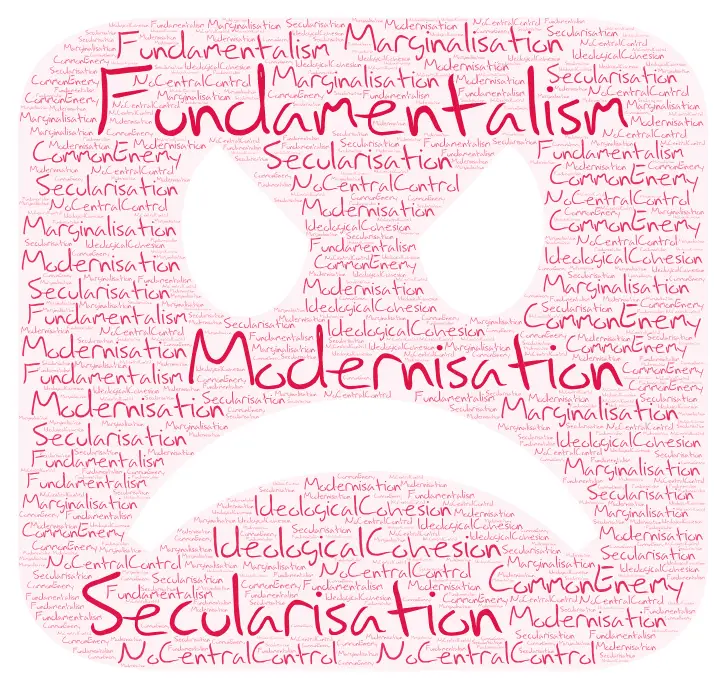
Steve Bruce argues that the main causes of Fundamentalism are modernisation and secularisation, but we also need to consider the nature of the religions themselves and a range of ‘external factors’ to fully explain the growth of fundamentalist movements.
Modernisation has undermined religion in at least three ways:
- Social life has become separated from religious life (linked to the process of di…