
beads from tomb m10 at zaouiyet el-mayetin | c. 3600 - 3000 BCE | predynastic egypt, naqada ii culture


Iberian Bronze Age Index: the arrival of the Bronze Age in Iberia after 2800 BC was not universal in its spread - it took a long time to gain traction in some areas, with areas of inland Iberia still only beginning the use of Chalcolithic metals.

i’m in the Neolithic (what?)
i’m in the Chalcolithic (what?)
i’m in the combination Neolithic Chalcolithic Anatol’ya
wait a minute — there’s painted pottery?
but nothing coppery
but the Anatolian Copper Age is about pottery


Çatalhöyük is a tell (a mounded accretion due to long-term human settlement) of a very large Neolithic and Chalcolithic proto-city settlement in southern Anatolia, which existed from approximately 7500 BC to 5600 BC and flourished around 7000 BC. In July 2012, it was inscribed as a UNESCO World Heritage Site.


Excavation revealed 18 successive layers of buildings signifying various stages of the settlement and eras of history. The bottom layer of buildings can be dated as early as 7100 BC while the top layer of the later West Mound is from 5600 BC.
Initial estimates suggested an average population of between 5,000 and 7,000. However, more recent work using revised ideas of the distribution of residential buildings, and employing archaeological and ethnographic data exploring building use, suggests that between 600 and 800 people would have lived at Çatalhöyük East during an average year during the Middle phase (6700–6500 BC).


figure of a fertility goddess | c. 3000 - 2500 BCE | cyprus, chalcolithic or bronze age

A reconstruction of an elite burial at the Varna necropolis, where the oldest golden artefacts’ in the world were found (4600 BC - 4200 BC).


Was in an archeological sort of mood.
From copper age Europe we have
. The globular Amphora culture 3400-2800 bc
. The Corded Ware Culture 3000- 2350 Bc
. Funnel Beaker Culture 4300- 2800 Bc
Drawn in graphite
I tend to get fixated on archeology sometimes.

A poster for The Lords of Salt exhibition dedicated to the 20th anniversary of the archaeological excavations of the Provadiya-Solnitsata Settlement Mound in Northeast Bulgaria. Poster by the National Institute and Museum of Archaeology of the Bulgarian Academy of Sciences
The special jubilee exhibition entitled “The Lords of Salt,” which was opened in June 2024 in Sofia, has just been extended…
A poster for The Lords of Salt exhibition dedicated to the 20th anniversary of the archaeological excavations of the Provadiya-Solnitsata Settlement Mound in Northeast Bulgaria. Poster by the National Institute and Museum of Archaeology of the Bulgarian Academy of Sciences
A special jubilee exhibition entitled “The Lords of Salt” has been opened in Sofia to showcase the most startling finds from…
The 5th century BC Scythian warrior’s bone scepter discovered at the Salt Pit Settlement Mound in Bulgaria’s Provadiya has become the August 2024 “Exhibit of the Month” of Bulgaria’s National Museum of Archaeology. Photo: P. Leshtakov, National Institute and Museum of Archaeology
A truly impressive and sophisticated artifact – a bone scepter that belonged a Scythian warrior from the 5th century…


The Ivory Lady, a powerful figure in Chalcolithic Iberia, as depicted by Miriam Lucianez Trivino.


April 2024
Chalcolithic period round house remains, c3500BC-2400BC, Lemba village, Cyprus, with an archaeological reconstruction of the buildings.

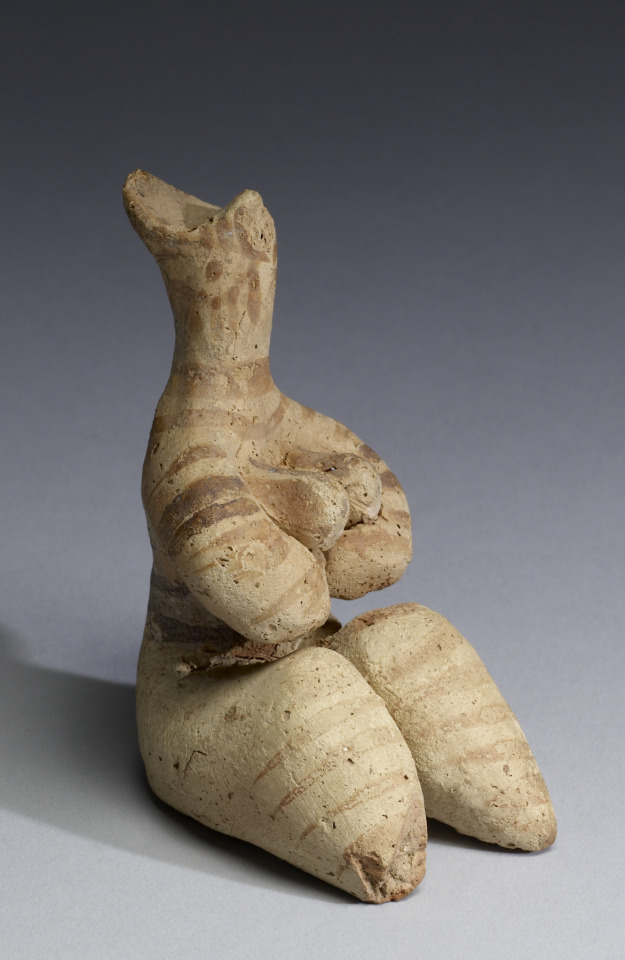
Tell Halaf Figurine
Syrian, 6th millennium BCE (Chalcolithic)
As early as the 7th millennium BCE, cultures in the Near East began to create organized settlements with well-developed religious and funerary practices. The Halaf culture of Anatolia (southern Turkey) and northern Mesopotamia is named for Tell Halaf in modern day Syria and is one example of such sophisticated early cultures. The Halaf culture flourished during the 6th millennium BCE and was notable for its ceramic productions, both its intricately painted pottery and remarkable female figurines.

The skull under study belonged to an adult female deposited in the second burial phase (2566–2239 years cal BCE). It exhibits in the anterior region of the right temporal fossa two contiguous and partially overlapping holes that correspond to two trepanations performed using the scraping technique.
Conclusions
It is a double cranial trepanation with signs of bone remodelling suggesting survival from surgery. No pathological signs were identified potentially associated with the intervention.


Mother Goddesses
Halafian
Northern Mesopotamia (Iraq), circa 4000 - 3000 BC
Ochre slip-painted earthenware
Chalcolithic period


Kaiser, E. (2019): Das dritte Jahrtausend im osteuropäischen Steppenraum. Kulturhistorische Studien zu prähistorischer Subsistenzwirtschaft und Interaktion mit benachbarten Räumen. Berlin Studies of the Ancient World. Vol. 37Edit. Topoi. ISBN: 978-3-9819685-1-4
Sinopse:
Os túmulos são característicos da cultura yamnaya e da cultura funerária das catacumbas do terceiro milênio A.C. na estepe da Europa Oriental e na zona de estepe florestal. Com o início da cultura yamnaya, os enterros são regularmente realizados em túmulos, os montes são frequentemente usados várias vezes e se transformam em monumentos ao longo do tempo.
+INFO em: O Terceiro Milénio na Estepe Europeia - Livro


