@ellekorea
Text


NASA Image of the Day (March 16, 2026)
Celebrating 100 Years Since Goddard’s Breakthrough Moment in Modern Rocketry
Dr. Robert H. Goddard and a liquid oxygen-gasoline rocket in the frame from which it was fired on March 16, 1926, at Auburn, Mass.
Image Credit: Esther Goddard, from the Clark University archive


Text

 ALT
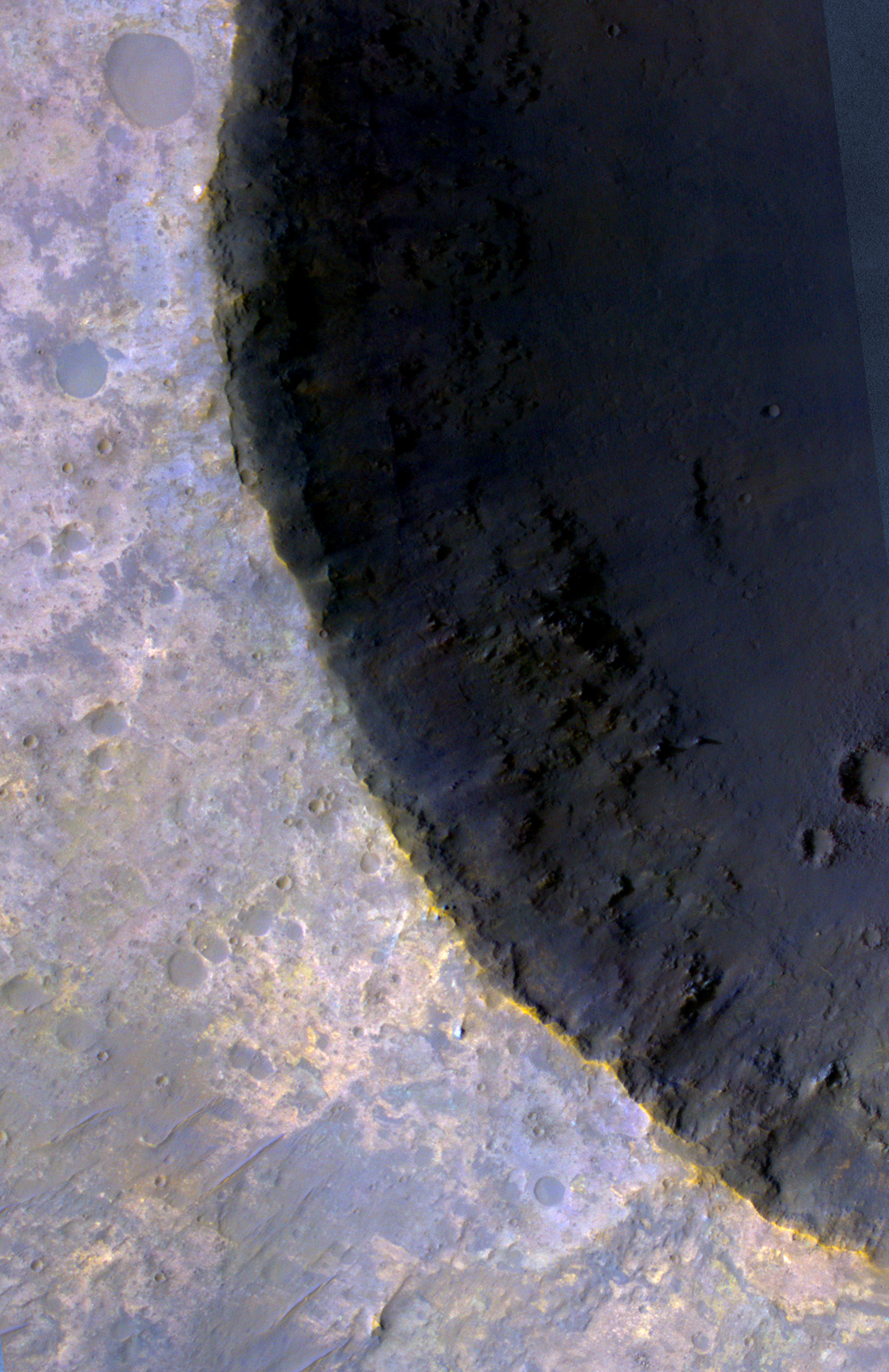
ALTHiPOD: Colorful Rocks near Chaotic Terrains
Chaos can be beautiful! This image covers rocky plains in a low-latitude area of Mars, which lie adjacent to pits containing scattered blocks of high-standing material, called “chaos terrains.”
The plains appear chaotic too, especially in enhanced color images that reveal the diverse range of rock compositions present. A closeup highlights this diversity, showing a range of colors arrayed around the western edge of a 1.3 kilometer-wide impact crater near the northern end of our full image. While the crater interior is shadowed in our late afternoon picture, the flat surrounding plains are well illuminated.
Cratering is itself chaotic, potentially altering rock compositions and randomly rearranging preexisting rocks, but with the benefit that it exposes them at the surface for our orbiting robotic eyes to see.
ID: ESP_090689_1695
date: 30 November 2025
altitude: 264 km
NASA/JPL-Caltech/University of Arizona
Text


Celebrating 100 Years Since Goddard’s Breakthrough Moment in Modern Rocketry
https://ift.tt/WVe0LN7
Dr. Robert H. Goddard and a liquid oxygen-gasoline rocket in the frame from which it was fired on March 16, 1926, at Auburn, Mass.
via NASA Image of the Day https://ift.tt/wpr0LV7
March 16, 2026 at 02:59PM
Text

Just had surgery that basically required shooting lasers in my butt. It was painless and docs were professional BUT IM PISSED BECAUSE LASERS DIDN’T SOUND LIKE ANYTHING. pathetic. could have at least made a low whirring noise like im an asteroid being mined for resources in outer space
Text


Eruption at Mayon
At any given moment, about 20 volcanoes on Earth are actively erupting. Often among them is Mayon—the most active volcano in the Philippines. The nearly symmetrical stratovolcano, on Luzon Island near the Albay and Lagonoy gulfs, rises more than 2,400 meters (8,000 feet) above sea level.
Historical records indicate Mayon has erupted 65 times in the past 5,000 years, with the latest episode beginning in January 2026. The Philippine Institute of Volcanology and Seismology (PHIVOLCS) first reported increased rockfalls near the volcano’s summit and inflation of the mountain’s upper slopes. On January 6, the alert level was increased to three on a five-level scale after lava began flowing from the crater and hot clouds of ash and debris called pyroclastic flows (also called pyroclastic density currents) moved down one side of the mountain.
The volcano was still puffing and lava flowing on February 26, when the OLI (Operational Land Imager) on Landsat 8 acquired this rare, relatively clear image. The natural-color scene is overlaid with infrared observations to highlight the lava’s heat signature. On that day, PHIVOLCS reported volcanic earthquakes, rockfalls, and pyroclastic flows. The longest pyroclastic flow had traveled about 4 kilometers (3 miles) through the Mi-isi Gully on the southeast flank.
The level-three alert, which remained in place in March, prompted evacuations within a 6-kilometer (4-mile) radius of the crater, displacing hundreds of families from communities including Tabaco City, Malilpot, and Camalig. Past pyroclastic flows have proven extremely destructive, leading to more than 1,000 deaths in 1814, at least 400 deaths in 1897, and 77 deaths in 1993. More than 73,000 people were evacuated during an eruption in 1984.
Sulfur dioxide (SO2) emissions during the current eruption have averaged 2,466 tons per day, with a peak of 6,569 metric tons measured on February 4, 2026. That is the highest SO2 emission level for one day in 15 years, the PHIVOLCS announced in early February. That was later exceeded on March 6, when SO2 emissions reached as high as 7,633 metric tons.
Multiple NASA satellites have also monitored the volcano’s sulfur dioxide emissions, showing sizable plumes of the gas drifting southwest on February 4 and March 6. The Philippine volcanology institute reported a peak in other activity on February 8 and 9, with 469 rockfalls, 12 major pyroclastic flows, and ashfall in the municipalities of Camalig and Guinobatan.
NASA Earth Observatory image by Michala Garrison, using Landsat data from the U.S. Geological Survey. Story by Adam Voiland.


Text

Astronomy Picture of the Day
2006 April 3

Stars and Dust Across Corona Australis
Credit: Adam Block, NOAO, AURA, NSF
Explanation: A cosmic dust cloud sprawls across a rich field of stars in this gorgeous wide field telescopic vista looking toward Corona Australis, the Southern Crown. Probably less than 500 light-years away and effectively blocking light from more distant, background stars in the Milky Way, the densest part of the dust cloud is about 8 light-years long. At its tip (lower left) is a series of lovely blue nebulae cataloged as NGC 6726, 6727, 6729, and IC 4812. Their characteristic blue color is produced as light from hot stars is reflected by the cosmic dust. The tiny but intriguing yellowish arc visible near the blue nebulae marks young variable star R Coronae Australis. Magnificent globular star cluster NGC 6723 is seen here below and left of the nebulae. While NGC 6723 appears to be just outside Corona Australis in the constellation Sagittarius, it actually lies nearly 30,000 light-years away, far beyond the Corona Australis dust cloud.
Authors & editors: Robert Nemiroff (MTU) & Jerry Bonnell (USRA)
NASA Official: Jay Norris.
A service of: EUD at NASA / GSFC
& Michigan Tech. U.
Text


Watched Project Hail Mary recently and I have to say, Mary (the spaceship/station?) is very beautiful
Not only that but planes were featured in the movie, and that was so cool, I was distracted by them the whole time,
And also I thought the robot that wakes Grace up in the beginning was cute too, I liked them


Text

My dad has a conspiracy that the astronauts on the Artemis launch are gonna die out there, and then Trump is gonna launch a whole propaganda campaign “space is dangerous we should stop spending money on it” god I HOPE not, but that’s totally something the US government would do to stop science and innovation, making people scared of it for decades to come. Absolutely evil but plausible stuff. Stay safe, NASA
Text


Canadarm2 poises to grapple a Cygnus cargo ship behind the Soyuz MS-12 spacecraft, Expedition 59.