Top 10+ Healthcare Management Project Ideas for MBA Students in 2026
Key Takeaways
➤ Healthcare projects help bridge the gap between classroom learning and real-world hospital challenges.
➤ High-demand areas in 2026 include AI-driven care, digital health, and sustainable hospital operations.
➤ A strong project acts like a “practical resume” that showcases real problem-solving skills.
➤ Industry-aligned mentorship ensures your research stays relevant and impactful.
Why Choosing the Right Healthcare Management Project Topic Is Difficult
Picking a project topic isn’t just about choosing something interesting. For MBA students, the goal is to demonstrate healthcare project analysis — the ability to solve real business problems in a medical environment.
Here’s why many students struggle:
➤ Data Privacy Issues: Access to real patient data is restricted due to strict regulations.
➤ Rapid Tech Evolution: Healthcare trends evolve quickly. A topic that worked in 2023 may feel outdated in 2026 due to AI, automation, and policy changes.
➤ Scope Confusion: Topics that are too broad feel overwhelming, while overly niche topics lack impact. The ideal topic should be practical, relevant, and manageable.
10+ Healthcare Management Project Ideas for MBA Students in 2026
Healthcare in 2026 is driven by technology, efficiency, and patient experience. Here are some impactful project ideas:
1. AI-Powered Healthcare Chatbot
Create a framework for an AI assistant that manages patient triage, FAQs, and appointment scheduling to reduce front-desk workload.
2. Telemedicine in Rural Healthcare
Study the feasibility of expanding specialist care to rural areas using 5G-enabled telehealth platforms.
3. Sustainable Green Hospitals
Analyze the ROI of adopting solar energy, energy-efficient infrastructure, and zero-waste practices in hospitals.
4. Medical Tourism Strategy in India
Develop a strategic marketing plan to promote India as a hub for specialized treatments like orthopedics and cardiology.
5. Reducing Emergency Room Wait Times
Apply Lean Six Sigma techniques to identify and eliminate bottlenecks in emergency admissions.
6. Health Insurance Claims Optimization
Explore how AI or blockchain can simplify and accelerate insurance claim approvals.
7. Mental Health Apps for Corporate Employees
Evaluate how digital wellness platforms improve employee productivity and mental health in corporate environments.
8. Smart Hospital Pharmacy Inventory
Use predictive analytics to maintain optimal medicine stock levels while reducing wastage and costs.
9. Patient Data Privacy and Cybersecurity
Design a security framework to protect electronic health records from cyber threats.
10. Wearables for Chronic Disease Monitoring
Analyze how wearable devices reduce hospital readmissions for patients with heart disease, diabetes, or hypertension.
11. Home-Based Geriatric Care Models
Create a scalable business model for elderly home care services focused on comfort and affordability.
Common Challenges Faced by MBA Students
Even with strong topics, healthcare projects come with challenges:
➤ Time Constraints: Many MBA students juggle work and studies, making deep research difficult.
➤ Limited Financial Data: Hospitals are cautious about sharing operational and financial details.
➤ Technical Complexity: Understanding medical terminology while applying management concepts requires balance.
One practical solution is using simulated datasets, academic databases, and mentorship guidance to make research both safe and insightful.
How Healthcare Projects Shape Your Career
Your final-year project can be a powerful career differentiator. Employers don’t just evaluate grades — they look for real-world problem-solving ability.
For example:
• A chatbot project demonstrates tech leadership.
• An ER efficiency project highlights operational expertise.
• A medical tourism strategy shows business acumen.
A well-executed project helps you build specialization early and positions you as a subject-matter expert even before graduation.
Final Thoughts
Healthcare management in 2026 is evolving rapidly with technology, sustainability, and patient-centric innovation. Choosing the right project not only strengthens your academic profile but also shapes your career direction. Focus on topics that solve real healthcare problems, leverage emerging technologies, and align with industry needs. A thoughtful project today can open doors to leadership roles tomorrow. Read more…
Top 10 Supply Chain Project and Mini-Project Ideas for Final Year Students (2026)
Introduction
The final year of your degree is one of the most important phases of your academic journey. For students pursuing an MBA in Operations or Supply Chain Management, the final project is more than just an academic requirement. It is your gateway into the professional world.
A well-chosen supply chain project bridges the gap between classroom learning and real-world logistics challenges. From inventory bottlenecks to last-mile delivery inefficiencies, your project gives you the opportunity to prove your ability to solve real industry problems.
Whether you are pursuing a regular MBA or an online program, selecting the right topic can significantly strengthen your portfolio and improve employability.
Why Supply Chain Projects Matter
A strong supply chain project acts as a preview of your industry readiness. Especially in online MBA programs, projects simulate real business challenges.
A good project demonstrates:
Analytical thinking
Problem-solving skills
Awareness of trends like automation, sustainability, and AI forecasting
Top 10 Supply Chain Project Ideas for 2026
1. Sustainable Procurement
Study how organizations select eco-friendly suppliers and reduce environmental impact across the supply chain.
2. Last-Mile Delivery Optimization
Analyze strategies to improve delivery speed and efficiency in urban areas.
3. Blockchain for Food Traceability
Explore how blockchain can track food products from farm to store, improving safety and transparency.
4. AI-Based Demand Forecasting
Use historical sales data to predict future demand and reduce stockouts.
5. Reverse Logistics for E-Waste
Study how companies manage product returns, recycling, and disposal sustainably.
6. Vendor Risk Management
Design contingency plans to manage supplier disruptions during global crises.
7. Warehouse Automation ROI
Compare manual operations with robotic automation and evaluate long-term cost benefits.
8. Cold Chain Logistics
Study temperature-controlled logistics used for transporting medicines and vaccines safely.
9. Lean Inventory Management
Analyze just-in-time inventory strategies to reduce storage costs and improve efficiency.
10. Resilient Global Shipping Routes
Evaluate alternative shipping routes to manage disruptions like port congestion.
Supply Chain Mini-Project Ideas
If you need smaller topics, mini-projects are ideal for short timelines.
Audit a local retailer’s inventory and suggest digital improvements
Study packaging waste and propose eco-friendly alternatives
Optimize delivery routes for local distributors using GPS data
Tools for Supply Chain Projects
Using modern tools can make your project more practical and impressive.
Tableau or Power BI for dashboards
Advanced Excel for modeling and forecasting
AnaLogic for logistics simulations
Python or R for predictive analytics
Common Mistakes to Avoid
Many students lose marks due to poor topic selection.
Avoid these mistakes:
Choosing vague topics like “Inventory Management”
Selecting topics without available data
Submitting overly theoretical projects
Always focus on practical, solution-oriented work.
How to Choose the Right Topic
Choosing the right supply chain topic should balance interest and market demand.
Pick a topic aligned with your strengths
Follow industry trends in logistics and e-commerce
Consult mentors to refine your idea
Many online MBA programs provide academic guidance and industry-aligned mentorship to help students create career-ready projects.
Your final project is more than an academic submission — it is your entry point into leadership roles in logistics and operations.
Online SRM programs emphasize industry-aligned curriculum, mentorship from subject experts, and practical exposure through real-world projects. With flexible learning formats and strong academic support, students can transform their academic work into professional success stories.
Final Thoughts
A well-planned supply chain project can define your early career trajectory. By choosing a topic aligned with industry trends and using modern tools, you can create a project that stands out to recruiters and academic evaluators alike.
Whether you aim to work in e-commerce logistics, manufacturing operations, or global supply chain strategy, your final-year project is your opportunity to make a lasting impression.
Best Finance Project Topics Every MBA Student Should Explore
A rich resource for MBA finance students — a curated list of 50+ project ideas and topics spanning portfolio analysis, credit risk, FinTech, stock-market prediction, sustainable finance, real-estate valuation, corporate finance, and more. Whether you want a simple research project or a cutting-edge fintech build, this guide helps you pick an industry-relevant, data-backed topic that boosts your skills and strengthens your resume. Perfect for final-year MBA students, freshers, or anyone aiming to stand out in finance.
Enhance your MBA research with impactful project topics in areas like Finance, Marketing, HR, Operations, and Business Analytics. Popular topics include Digital Marketing Strategies, Supply Chain Optimization, Consumer Behavior Analysis, Financial Risk Management, and AI in Business Decision-Making. These projects provide practical insights into real-world business challenges Read More…
Enhance your MBA research with impactful project topics in areas like Finance, Marketing, HR, Operations, and Business Analytics. Popular topics include Digital Marketing Strategies, Supply Chain Optimization, Consumer Behavior Analysis, Financial Risk Management, and AI in Business Decision-Making. These projects provide practical insights into real-world business challenges Read More..
Quality and Quality Management System at Barclays Group
Quality Management System at Barclays Group - The present business climate is characterised by fierce rivalry and constantly shifting client needs. A further factor driving competition is the proliferation of new technology, globalisation, and corporate consolidation (Bouranta et al., 2019). Many banking institutions are suffering economic issues because of the COVID-19 epidemic. Managers must examine their company processes in light of the negative macroeconomic climate to make investment decisions.
This report evaluates Barclays’ quality management procedures and investment decision processes (Kugbonu, 2020). Quality management trends are also examined in this paper, as well as how the QM system might be aligned with these trends. Barclays bank should incorporate these trends into its Quality Management (QM) to achieve a competitive edge in the business.
An Overview of the Situation
This bank has two divisions: Barclays International and Barclays UK. Its service subsidiary, Barclay’s execution services, supports these divisions. Over 83,000 people work for the bank, which has operations in 40 countries and employs approximately 83,500 people in its two primary markets, the United States and the UK (Diekola, 2016).
Personal banking, commercial banking, investment management, corporate banking, and internet banking are just some of Barclays’ many offerings. In addition to individual and small business banking, the bank also provides corporate and investment banking services.
TQM Principles at Barclays and its Significance TQM
Employee Engagement
The HR department’s TQM principles include employee involvement and open communication. Human capital is a key strategy for the bank in achieving its objectives (Salah, 2018). “We want to promote their health and well-being to empower and drive them to offer exceptional services” the business said in a statement.
To boost productivity, the company makes significant investments in the well-being, professional growth, and mental health of its workers. 83 per cent of the bank’s employees say they’re engaged, with 67 per cent of those surveyed responding (Nyamari, 2017).
According to employee surveys, between 74% and 78% of employees report having stress levels they can manage and a work-life balance they feel they have achieved (Parvadavardini et al., 2016). To foster a culture of innovation and creativity amongst its workers, the bank offers a variety of educational opportunities, including classes, workshops, and seminars.
Internal clients are just as crucial as external ones when it comes to a company’s success. Internal customers and external customers can both benefit from service firms’ efforts to improve the quality of the services they provide (Rafailidis et al., 2017). Human resource policies including organisational commitment, employee engagement and training are connected to optimal corporate performance and shareholder profitability. There are ways in which Barclays’ present HR policies can contribute to its long-term competitive advantage.
Communication
An annual poll of employee engagement is conducted by the corporation, allowing for two-way dialogue between top management and the workforce. Employees, consumers, investors, and stakeholders all have input in decision-making and strategy formation (Kugbonu, 2020). To help clients make well-informed financial decisions, the organisation says it is transparent about its financial offerings. The corporation engages stakeholders using surveys, social media, and other broadcast methods.
Using Kaplans and Nortons Balanced Scorecard, the company’s communication’s organisational impact may be measured (BSD). The BSD aims to improve the quality of life for both employees and the general public via better communication (Al Ghamdi et al., 2016). To create connections and satisfy consumers, Kaplan and Norton’s approach requires management to communicate. To boost performance and customer happiness, the leaders need to convey their priorities effectively.
Management
Nyamari (2017) emphasised the importance of leadership in achieving quality objectives in a business. To keep their teams focused on the pursuit of quality improvement, bank leaders instil a sense of urgency in them. Demonstrate a high level of leadership and management to lead the radical adjustments necessary for continuous improvement, Deming claims.
To increase productivity and revenues, transformational leadership may enhance the quality of the entire process (Diekola, 2016). Leadership at Barclays is responsible for establishing the bank’s long-term strategy and defining its basic principles. To help their employees achieve their goals, they are also directly involved.
Significance of TQM Principles at Barclays
An Ever-Evolving Process
This bank has a section dedicated to service and efficiency enhancement. The lean six sigma paradigm, which states that a corporation may enhance product/service quality by removing wastes along the value chain, is used by the company to accomplish continuous improvement (Bouranta et al., 2019).
Focusing on theory implies that proper precautions are taken to prevent errors and increase operational efficiency. The business says that it recycles risk-weighted assets to improve operational performance and keep costs in check while also maximising the efficient use of available resources.
To reduce inefficiencies caused by inefficient work methods, it has also used new technologies in the invoicing and documentation procedures (Salah, 2018). Banks may enhance their financial and non- financial performances as well as their operations related to supplying chain management by making investments in continuous improvement. The bank’s performance may be improved through operational efficiency and better customer service as a result of the continuous improvement projects.
Customer-Focus
For the bank, customer-focused service is a primary value proposition. Customers’ wants and connections are at the heart of all of the company’s actions and plans. Investment programmes can be adjusted to match the specific demands of each customer (Rafailidis et al., 2017). Access and tracking of investments are available online for clients. As a part of its financial education programme, the bank offers free telephone updates and money-mentoring services.
Barclays Bank also provides new goods and services to enhance the customer experience (Mahanga, 2016). For instance, consumers may save time by serving themselves and gaining access to the majority of the bank’s goods and services through the use of the bank’s mobile applications and online banking platform.
Customers from a variety of backgrounds may simply use the applications because of their basic design. In accounting and banking organisations, customer-centred services improve client happiness, customer loyalty, and customer retention levels (Parvadavardini et al., 2016).
These findings suggest that a company’s ability to retain customers may be improved by tailoring technology to match the demands of clients. In today’s highly competitive market, a company’s ability to retain and gain new customers is vital (Kugbonu, 2020).
According to the bank, a 32 per cent decrease in customer complaints may be attributed to the bank’s efforts to enhance its service delivery method. Customer service is a priority for the organisation, and it has taken the necessary steps to improve it.
The bank’s operations with reduced defect and waste creation can boost productivity and create cheaper expenses. Additionally, the bank may be able to maintain and grow its client base, resulting in greater financial success (Al Ghamdi et al., 2016). TQM’s societal advantages include customer happiness and brand approval in the marketplace.
To complement the bank’s quality plan, these TQM principles need to be adapted. Using the TQM principles, the bank may fulfil its strategic goals of diversification by implementing four proposals (Diekola, 2016).
TQM impacts competitive strategy creation and is a source of sustained competitive advantage, according to research (Nyamari, 2017). A competitive advantage may be gained through the use of the TQM paradigm, according to these studies. Using the 14 TQM principles, a firm may have a competitive edge, better financial performance, and better customer satisfaction.
This is confirmed by the company’s 2020 annual report, which notes that the improvement in customer satisfaction may be ascribed to the company’s quality measures (Mahanga, 2016). Because it concentrated on TQM principles, the bank’s financial results have improved.
The Importance of Total Quality Management Barclay’s Quality Management System (QMS)
Building a Quality Management System begins with understanding the current organisational environment, which includes things like structure and culture as well as a leadership style (Akanmu et al., 2020). Customer satisfaction was a key consideration in the development of Barclays’ quality management system.
EFQM is evident in the bank’s procedures, which have been scrutinized in depth by the bank’s auditors. To achieve excellence, the EFQM relies on five enablers and four outcomes (Carmona et al., 2016). Enablers are concerned with how a company accomplishes its work, whereas outcomes are concerned with the results it achieves. Results are generated through enabling factors, while enablers may be enhanced via the use of feedback from those results (Khan et al., 2017).
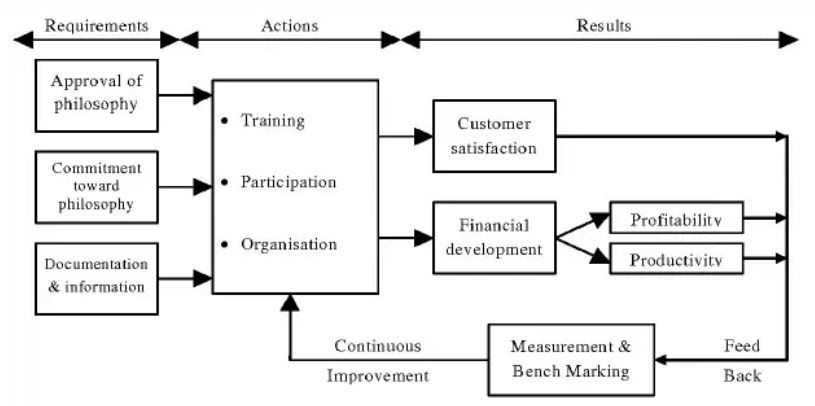
This methodology helps the company to examine its real condition according to European quality measures and determine its advantages and disadvantages in accomplishing goals (Harthy et al., 2020). Within the annual report, Barclays says it gathers and assess information on the 9 EFQM model criteria and employs the applicable improvement plan to boost each criterion’s performance. The bank’s planned quality management system (QMS) looks like this.
Quality Management System Dissertation
The EFQM model establishes the framework for QMS quality measurements to be focused on, as seen in the image above. It collects information on EFQM enablers, including employees, leadership, strategy, and products/services (Elrayeh, 2016). Customer satisfaction feedback is utilised as a quality indicator for the people criteria, whereas financial development data is employed as a metre for products and services (Waduu et al., 2019).
These quality criteria are a reflection of the leadership’s commitment to employee development, involvement, and the organization’s overall mission. Continuous improvement is possible because of this system’s design (Mahmood, 2020). The subsequent phase is to formulate quality policies, define roles and duties within the QMS, make a strategy for the management of risks and opportunities, and, as the last step, devise strategies for the regulation of change.
Elements of TQM
There are several fundamental QM components and building blocks, including ethics, integrity, trust, education, collaboration, leadership, and recognition. An employee’s code of ethics is a set of rules that he or she is expected to follow at all times while at work (Harthy et al., 2020) Customers both internal and external expect the bank to uphold a high standard of integrity.
Ethics and integrity lead to trust, which in turn determines the level of ownership and dedication to an organisation. Ethics and integrity are demonstrated through the bank’s CSR, which can be found in its society criteria in the EFQM (Odeny, 2016).
With so much face-to-face contact between customers and staff, the foundation of every successful business is solid training, collaboration, and strong leadership. TQM training helps employees acquire the skills and information they need to properly execute the concepts (Khan et al., 2017). For the bank to meet its quality goals, staff must work together as a team. Investments in quality assurance are a sign of the company’s dedication to quality management.
Quality Assessment Standards
An ISO 9001 certification indicates that the bank meets the quality standard. International quality assurance standard ISO 9001 offers precise QMS standards for the company’s leadership, planning, operating, assessment and improvement activities (Odeny, 2016). Such measurements are used by organisations to demonstrate their capacity to fulfil all applicable consumer and regulatory criteria for their products and services.
The TQM system helps banks achieve their strategic goals by satisfying the needs of their customers (Ishibashi et al., 2021). The QMS can assist the bank in achieving its strategic objectives by meeting the demands of all stakeholders. The QMS is linked to banks’ strategic goals by aligning it with stakeholder needs.
Quality Metrics for Stakeholders
The bank provides quality for all stakeholders by regularly reviewing ways to enhance metrics to satisfy their demands (Carmona et al., 2016). Various types of stakeholders’ data are gathered, including the following:
Customers
- Rates of digital involvement with clients
- Complaint scores are a measure of consumer satisfaction
- The number of bank workers who advocate working there
- Customers who would suggest the bank’s products and services to their friends and family members
- Monitoring the degree to which workers are aligned with the intended company culture is the goal of this indicator
Society
- The yearly carbon dioxide emissions
- Number of participants in the institution’s Life Skills programme; the bank hopes to increase financial capability and employability in the community
Investors
- The bank examines financial results such as revenues, market shares, operating expenses, and equity to determine how to provide attractive returns for investors (El Manzani et al., 2019). Measuring the operational costs aims to tighten budgets and increase productivity for the business.
Key Trends in Quality Management
Competition and increasing consumer expectations are the primary motivators of quality management. Stakeholder opinions of a company’s brand and overall quality/services are referred to as perceived quality (Bagur-Femenías et al., 2016). Intelligent quality management uses modern technology and smart systems to improve corporate operations, processes, and product quality (Kumar et al., 2018). The human-focus strategy leverages people to satisfy the company’s service offerings and stakeholder satisfaction.
These tendencies are important to consider since the example firm operates in a sectorof the economy that is highly competitive and marked by consistent market shifts (Barclay et al., 2017). A good example of a cloud-based technology user is the banking industry. Barclays has also adopted cloud technology to customise its clients’ digital experience to current technological advancements.
Companies that go out in front of the game or catch up quickly are more likely to have a leg up on the competition (Demir et al., 2021). That’s why it’s so important for a firm to be up to date on the latest trends to remain relevant in the marketplace.
Cloud computing, in keeping with current market demands, shows the company’s capacity to implement intelligent quality control systems (Hicks et al., 2019). Barclays also places a high value on its social duties, including reducing its impact on the environment and combating climate change. Perceived quality is directly linked to a brand’s image, regardless of its corporate social responsibility (Leung et al., 2021).
Many studies have shown that a company’s CSR policies have an impact on customer happiness and loyalty as well as its financial performance. Customers’ impressions of a company are shaped by their impressions of its perceived quality, which in turn shapes their loyalty to the brand.
Human-centeredness is seen in the bank’s culture of soliciting input from its stakeholders to enhance its business practices. Human-centred strategies lead to higher levels of employee loyalty and productivity (Nyanaro et al., 2018). There is a correlation between a company’s ability to compete in the long term and its ability to develop and retain its human resources.
Intelligent quality management systems, which monitor and forecast problems with minimum human interaction and allow real-time communication with stakeholders, can also help the bank achieve its quality targets at a cheap cost (Tahri, 2018). Barrington can use evidence-based methods to improve and make decisions.
Quality Management System Alignment Expectations with the Trends
These new trends will be easier to implement if the organisation has the right resources and competencies in place. For a smooth transfer, you need financial resources, skills, and a well-trained team behind you (Demir et al., 2021). In addition, the business may assist such adoptions by reconfiguring its approach well with current developments in Quality Management. Incorporating QM trends into new strategic goals allows it to realign its overall strategy.
Having a strategy aligned with current trends will ensure that resources are allocated accordingly (Maina, 2017). These new trends may be adopted by empowering and encouraging individuals to accept the organisational transformation. Employees can be retrained or reskilled to help them adapt to the new environment.
New quality initiatives may face difficulties in gaining stakeholder buy-in. QM often fails because of CEO disinterest. Even if intermediate management is successful, success is unlikely without upper management’s commitment (Hicks et al., 2019). Risk aversion and a lack of understanding of the relevance of Quality Management have contributed to the lack of CEO support for a created project.
Investment may be discouraged by the high cost of implementing and maintaining QM trends, particularly intelligent quality management systems (Desjardins, 2020). The administration may be reluctant to continue funding the project if it does not show a favourable return on investment.
Conclusion
The quality management procedure at Barclays has been modified to incorporate the concepts of customer orientation, leadership, continuous improvement, communication, and staff involvement (Tahri, 2018). Customers’ loyalty and retention are enhanced by the bank’s TQM, which adds favourably to its financial performance and productivity.
Investors should seriously examine TQM as an alternative source of competitive advantage in light of the competing demands in the business sector (Hudnurkar et al., 2019). For the firm to reach its greatest potential, it needs its entire support.